Brake & Suspension Repair
Complete brake system and suspension services for maximum safety.
Truck Brake and Suspension Repair Kingman AZ
The stopping system is the most critical safety component on any commercial vehicle. On Arizona's steep mountain grades along I-40 and US-93, properly functioning air brakes are the difference between a controlled descent and a runaway truck. Weldon's Truck & Trailer provides complete stopping system and suspension repair for Class 8 diesel truck and heavy duty commercial vehicles from our Kingman, AZ base — mobile repair dispatched to your location, available 24/7.
Why Stopping System and Suspension Health Matter on Arizona Highways
Arizona's highway system puts extraordinary demands on commercial truck stopping systems and suspension. Interstate 40 crosses the Black Mountains east of Needles with grades steep enough to require runaway truck ramps — a truck with out-of-adjustment friction shoes or dragging linings can build drum heat fast enough to cause fade or fire on the descent. US-93 through the Hualapai Mountains south of Kingman presents similar challenges. Beyond the safety risks, a single out-of-service violation during a DOT Level 1 roadside inspection results in immediate shutdown, hefty fines, and a CSA score hit that follows your carrier for 24 months. A failed pushrod travel measurement — stroke exceeding the DOT out-of-service limit — is one of the most common reasons commercial vehicles are sidelined in the Southwest. Weldon's specializes in keeping every axle in full DOT compliance so every inspection passes the first time.
How Commercial Truck Air Systems Work
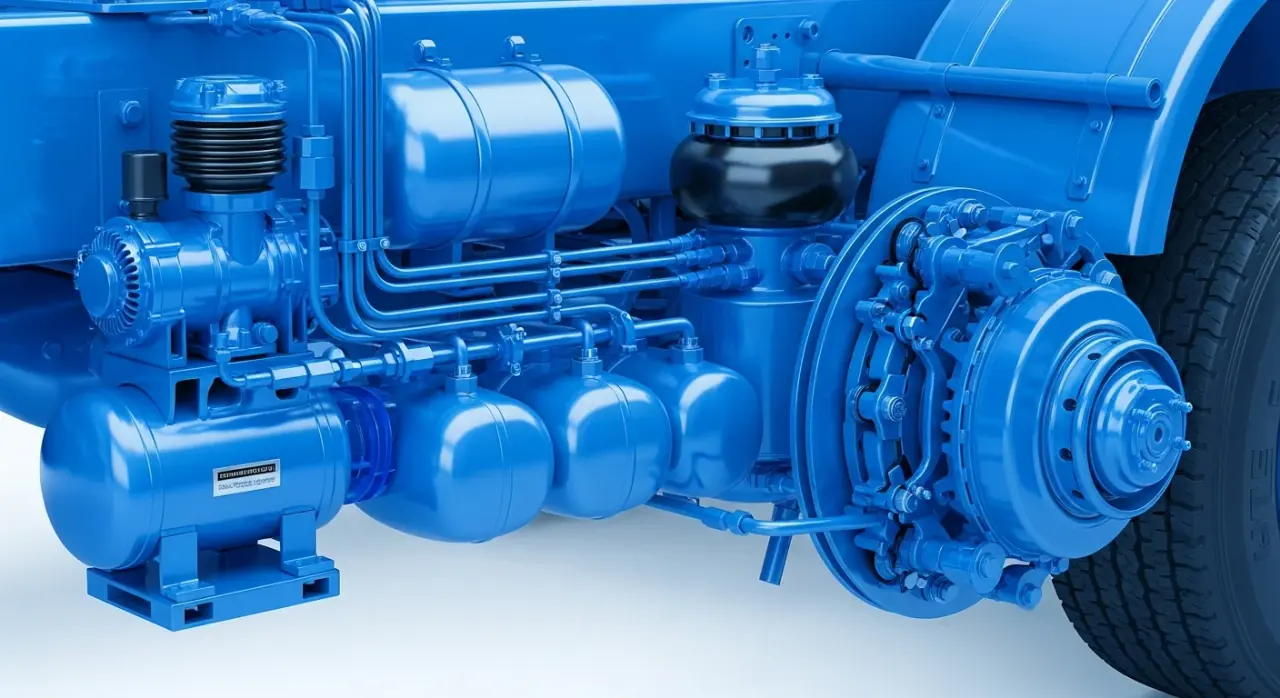
Unlike hydraulic systems on passenger vehicles, commercial trucks use compressed air to actuate the chambers that push friction shoes or pads against the drum or rotor. The system begins with an engine-driven air compressor that feeds primary and secondary air tanks through the air dryer. When the driver applies the pedal, a relay valve delivers air pressure to the chambers at each wheel end. S-cam assemblies — the standard on North American Class 8 trucks — use the chamber's pushrod to rotate an S-shaped cam that spreads friction shoes against the drum. The entire system is governed by strict DOT regulations covering air pressure build time, governor cut-in and cut-out settings, and pushrod travel limits. A thorough understanding of this system is what separates a qualified heavy duty technician from a general mechanic, and it is the foundation of every repair Weldon's performs.
Drum vs. Disc Systems on Class 8 Trucks
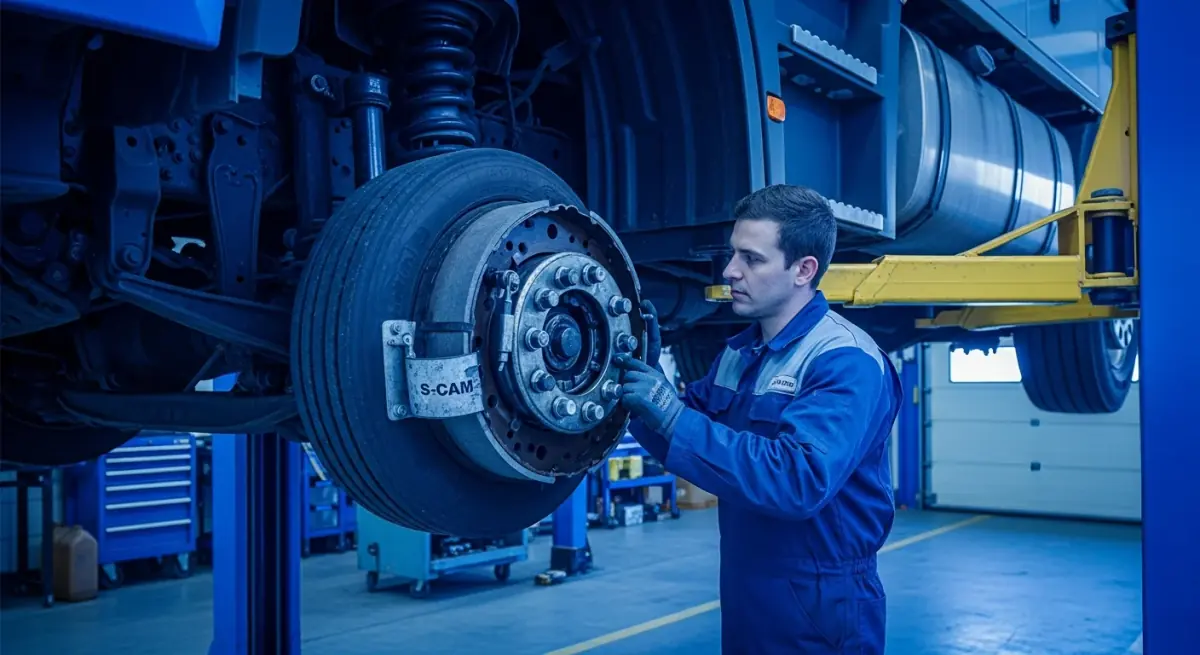
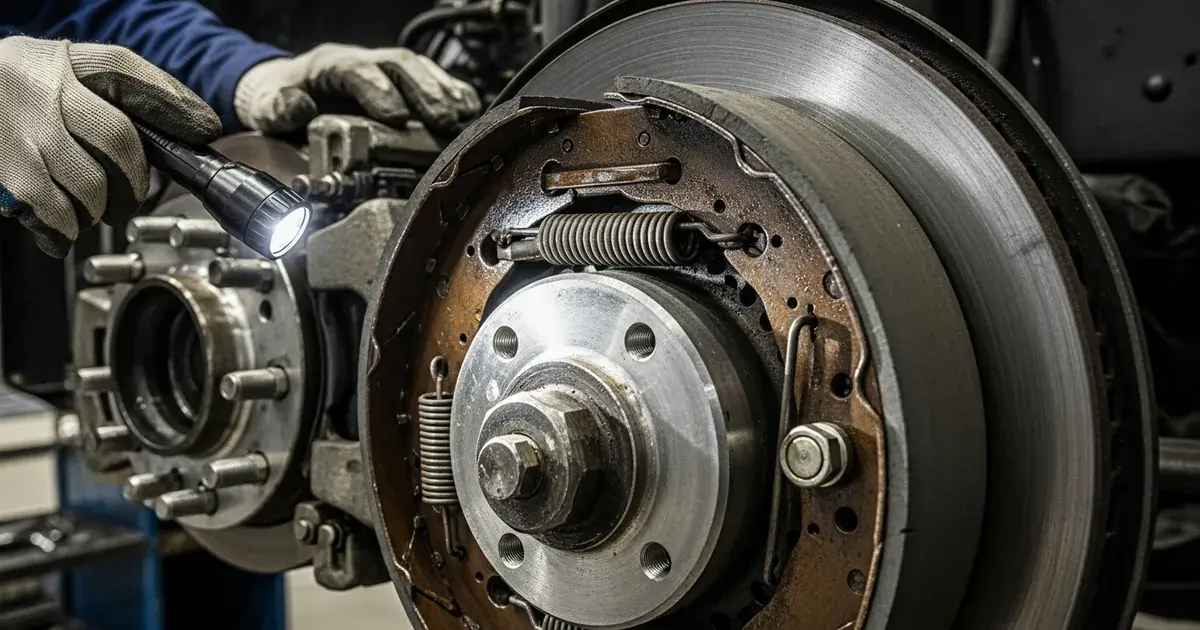
S-cam drum assemblies remain the industry standard for drive and trailer axles on Class 8 trucks, valued for durability and repairability. Disc configurations are increasingly common on steer axles and some European-platform trucks, offering superior heat dissipation and more consistent stopping performance in mountainous terrain. Drum system service involves measuring drum wear and out-of-round condition, inspecting lining thickness, and adjusting or replacing slack adjusters. Disc system service involves measuring rotor thickness and lateral runout, inspecting caliper operation, and replacing pads. Both configurations are subject to the same DOT out-of-service criteria — worn linings, cracked drums or rotors, and inoperative chambers all fail a Level 1 inspection. Our technicians are trained and equipped to service both on all major truck brands.
Air Chambers and Spring Actuators
Air chambers convert compressed air pressure into mechanical force at each wheel end. Standard service chambers handle normal stopping applications, while spring actuators — often called piggyback chambers — combine a service chamber with a spring-loaded parking mechanism that holds the vehicle when air pressure is released. Worn or cracked diaphragms cause air leaks that reduce stopping force and create an audible hiss that both drivers and DOT inspectors notice immediately. We replace chambers and spring assemblies on steer and drive axle positions. Spring caging — a safety procedure required before handling a pressurized spring actuator — is performed on every replacement to prevent injury. We stock Type 20, Type 24, and Type 30 chamber sizes to cover the range of common Class 8 configurations.
Slack Adjusters — Manual and Automatic
The slack adjuster links the chamber pushrod to the S-cam shaft and controls pushrod travel — the critical measurement that determines whether your stopping system is in or out of DOT compliance. Manual slack adjusters require periodic adjustment by a qualified technician to maintain proper stroke. Automatic slack adjusters (ASAs) are designed to self-adjust, but they do fail — a frozen or internally worn ASA allows pushrod travel to creep out of spec without any obvious warning to the driver. We inspect slack adjuster function on every service call, measure pushrod travel against DOT stroke limits, and replace any ASA that is not maintaining proper adjustment. We use OEM and premium aftermarket adjusters from Haldex, Meritor, and Gunite.
ABS Diagnostics and Anti-Lock System Service
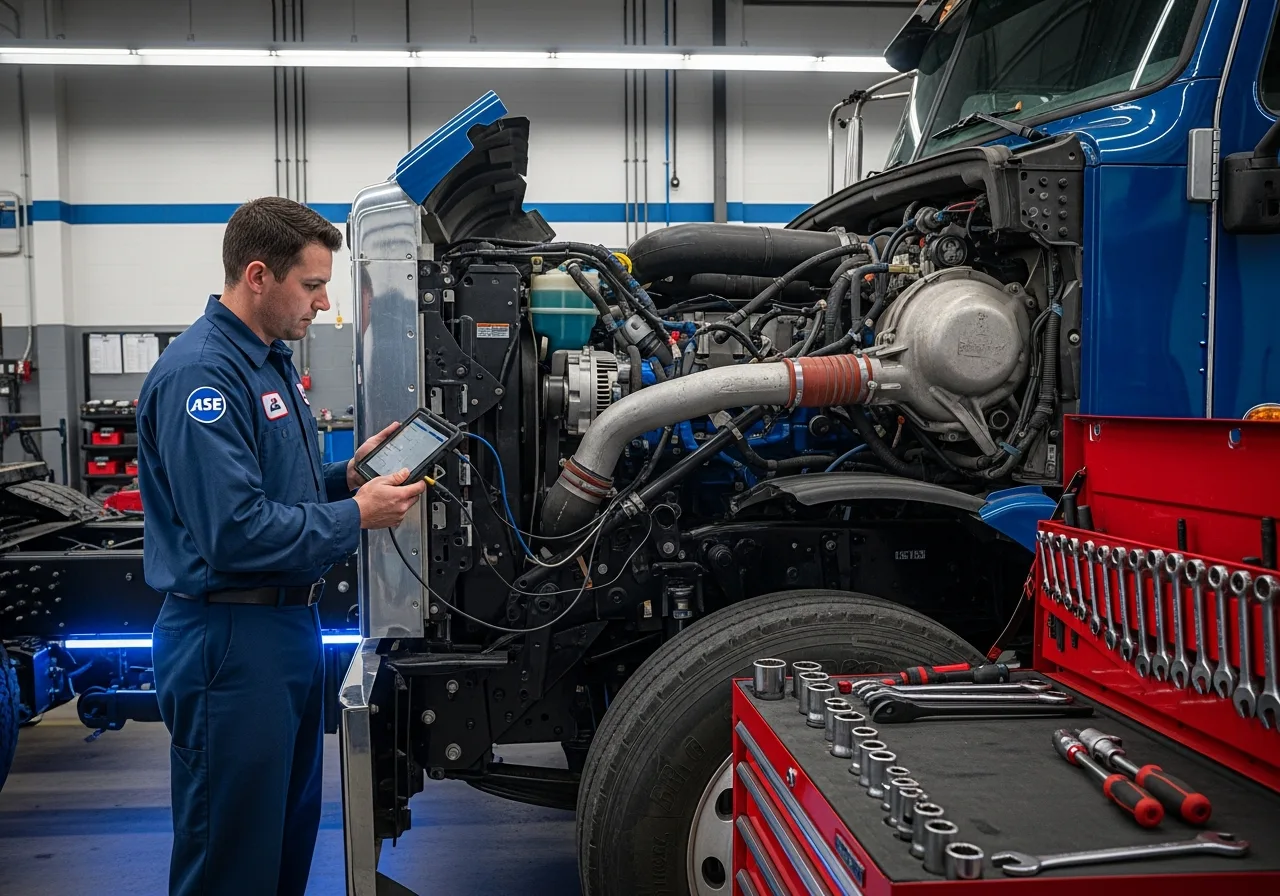
Anti-lock systems prevent wheel lockup during hard stops, significantly reducing stopping distance on wet or loose surfaces. ABS is mandatory on all air-system tractors and trailers built after 1997, and ABS faults can be flagged at DOT roadside inspections. Common failure points include wheel speed sensors contaminated with metallic debris, tone rings with damaged teeth, and failed ABS modulator valves. We perform ABS diagnostics using factory-compatible scan tools — reading fault codes, actuating individual components for testing, and clearing codes after repair. We replace wheel speed sensors, sensor brackets, tone rings, and ABS modulator valves across major system brands including Bendix, Wabco, and Meritor WABCO.
Friction Shoes, Linings, and Drum Replacement
Shoe replacement is one of the most common commercial truck maintenance items, yet it is frequently deferred until linings are dangerously thin or drums are heat-damaged. DOT regulations specify minimum lining thickness — typically 1/4" on drum configurations. Below that threshold, the steel backing plate contacts the drum directly, destroying the drum surface and creating sudden, severe stopping fade. We measure lining thickness on every axle and replace shoes as a complete axle set to ensure balanced retarding force. Drums are measured for diameter, out-of-round condition, and heat checking before deciding whether to turn or replace. A heat-checked or cracked drum will not survive reuse and creates a risk of sudden fracture under load. We stock shoes and drums for all common axle configurations including Meritor, Dana Spicer, and Hendrickson.
Air Dryer and Compressed Air System Maintenance
The air dryer removes moisture and oil from compressed air before it enters the stopping system. A failed dryer allows water to accumulate in tanks and lines, causing corrosion in control valves, freezing of small orifices in cold weather, and contamination of diaphragms. We service and replace Bendix AD-9, AD-IS, and Wabco air dryers — cleaning or replacing the desiccant cartridge, inspecting purge valve function, and testing system pressure maintenance. We also drain and inspect primary and secondary air tanks, inspect the governor valve and unloader mechanism on the compressor, and verify that air pressure build time meets DOT specifications for the vehicle's total system volume.
Stopping Fade on Mountain Grades — A Real Risk in Arizona
Stopping fade is a reduction in retarding effectiveness caused by overheating drums or rotors. On extended downgrades like those on I-40 in the Black Mountains, a loaded semi truck with improperly adjusted slack adjusters can build drum temperatures high enough to glaze lining material and dramatically reduce stopping force. Fade typically happens because too much work is concentrated on a few axles — the result of out-of-adjustment ASAs on other axles preventing balanced retardation. We check adjustment on all axles simultaneously, ensuring the stopping load is distributed evenly so no single axle reaches dangerous temperatures on Arizona's descents.
Leaf Spring Suspension Service
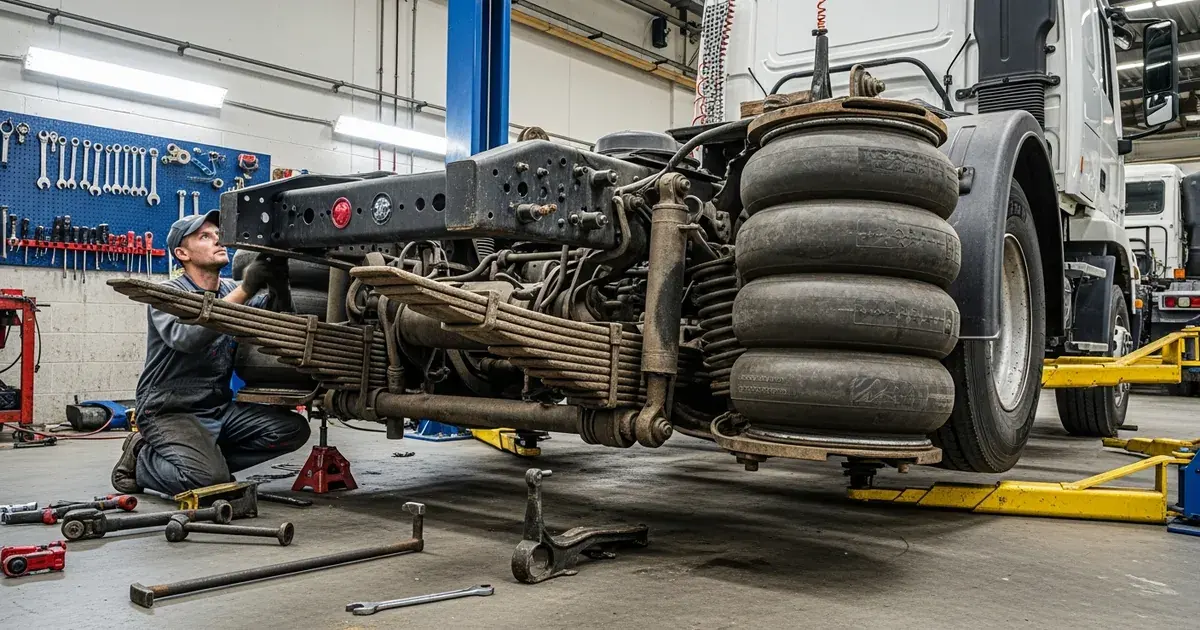
Leaf spring suspension is the traditional workhorse of heavy duty truck suspension, valued for load-carrying capacity and simplicity. Over time, leaf springs fatigue and develop cracks, individual leaves break, and the spring pack loses its arch — causing the vehicle to sit lower on one side and creating axle alignment problems that accelerate tire wear. We inspect spring packs for cracked or missing leaves, worn center bolts, and deteriorated bump stops. Broken springs are replaced as complete packs to restore the original spring rate. We also replace worn spring pin bushings and shackle bolts — worn bushings allow axle wander that causes tire cupping and directional instability under deceleration.
Air-Ride Suspension Service
Air-ride suspension uses air springs and shock absorbers to provide a smoother ride and better load isolation — particularly valuable for temperature-sensitive or fragile freight. The system relies on ride height control valves that maintain set air spring pressure regardless of load. When valves fail or air bags develop leaks, the truck or trailer rides at the wrong height, affecting fifth wheel clearance, tire clearance, and landing gear operation. We replace failed air spring assemblies, service height control valves, and assess shock absorber condition on air-ride equipped tractors and trailers. We also diagnose ride height control failures that cause the unit to sit unevenly — a condition that can cause dock leveler issues and uneven tire loading on dual wheels.
Spring Hangers, U-Bolts, and Frame Brackets
Spring hangers and U-bolts are the structural connections that anchor the axle to the frame. Cracked spring hanger brackets are a frequent failure on high-mileage equipment, allowing the axle to shift laterally so the truck tracks crookedly — a condition called dog-tracking. Loose or broken U-bolts allow axle rotation, which throws off chamber alignment and pinion angle on drive axles. We inspect and replace spring hanger brackets, U-bolts, U-bolt plates, and associated nuts — torquing all fasteners to manufacturer specifications. Cracked frame brackets are welded and reinforced in the field using our mobile equipment, eliminating the need for a shop visit.
Shock Absorbers and Ride Quality
Shock absorbers control axle oscillation after road impacts. Failed shocks cause the axle to bounce, leading to tire cupping — an irregular wear pattern that destroys tires prematurely and increases replacement costs. On a loaded semi, bouncing axles also cause momentary loss of tire-to-road contact, reducing stopping effectiveness during hard applications. We test shocks for fluid leakage, internal bypass, and mounting bushing wear, replacing them in matched pairs per axle from Bilstein, Gabriel, or OEM suppliers to maintain balanced damping across all wheel positions.
Kingpin and Steer Axle Geometry
Kingpins are the vertical pivot pins on the steer axle that allow the front wheels to turn. Worn kingpins allow excessive steering play — a shimmy or wander condition — and are a DOT out-of-service violation when wear exceeds specification. We measure kingpin wear with dial indicators per CVSA procedure and replace worn pins when they exceed the allowable limit. Kingpin replacement requires a hydraulic press and proper tooling that we carry on our service trucks. After replacement, we check tie rod end condition and recommend a front-end alignment to verify camber and toe settings are within specification for safe highway operation.
Wheel Bearings and Hub Inspection
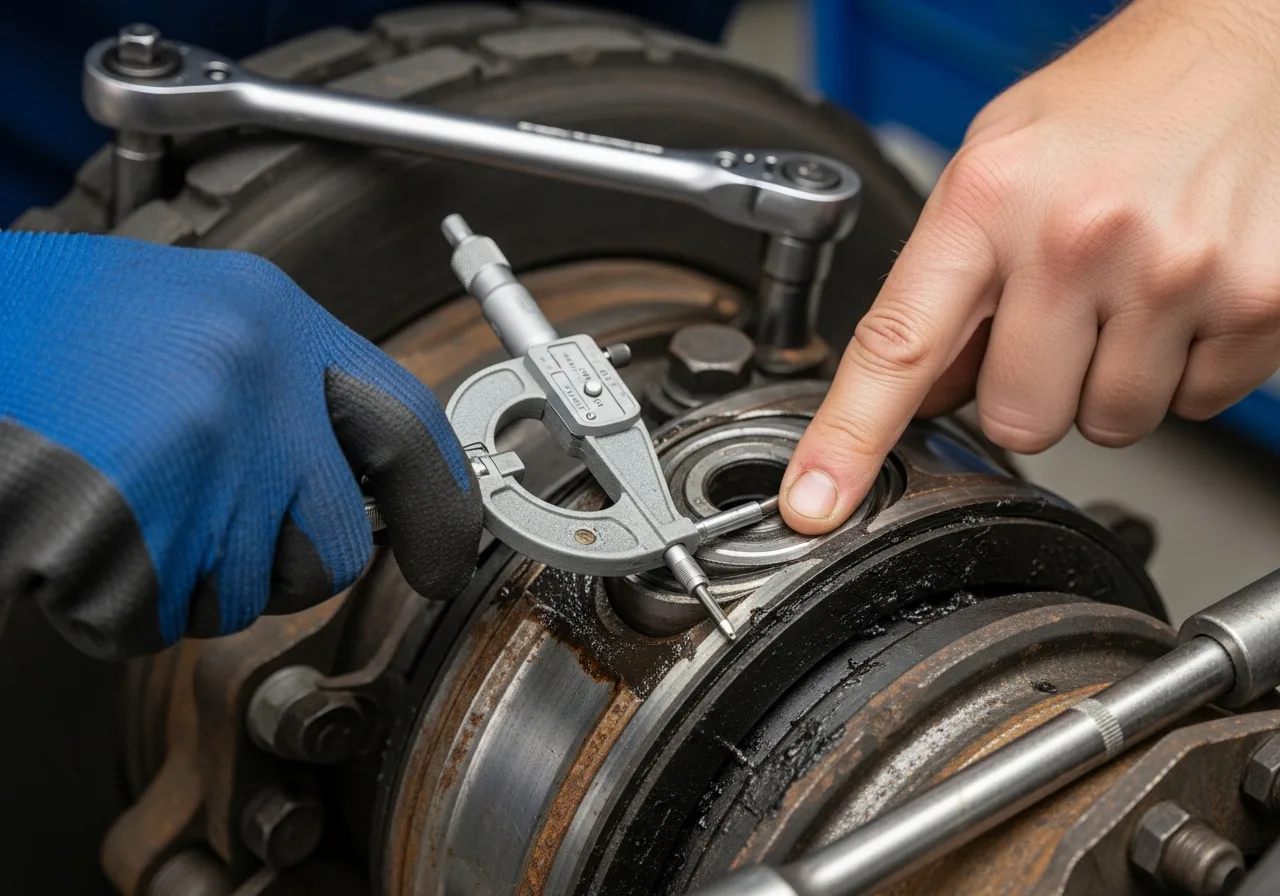
Wheel bearing condition directly affects stopping system performance. A bearing with excessive end play allows the drum to shift laterally during hard stops, causing uneven shoe contact and premature one-sided lining wear. We inspect wheel bearing adjustment using dial indicators to measure hub end play, adjusting tapered roller bearings to correct preload and replacing those worn beyond service limits. Every drum service call includes a wheel bearing inspection — catching bearing problems before they escalate into a wheel-off event on the highway.
DOT Inspection and Out-of-Service Criteria
The Commercial Vehicle Safety Alliance (CVSA) publishes out-of-service criteria that DOT inspectors use during Level 1 roadside inspections. The most common stopping-system OOS violations include: pushrod travel exceeding the maximum stroke limit for the chamber size; linings at or below minimum thickness; cracked or missing drums; audible air leaks at chambers or lines; inoperative ABS warning lamps; and missing or defective slack adjusters. A single out-of-service order can immobilize your truck for hours and generate a violation that affects your carrier's CSA score for 24 months. Weldon's performs a complete pre-release check against DOT out-of-service criteria after every repair — including brake repairs of all types — so you leave knowing the system will pass the next DOT stop.
Warning Signs Your Stopping System Needs Service
Indicators That Require Immediate Attention
Most failures give warning before they become dangerous. Call Weldon's if you notice any of these: a hissing or air-leak sound when pressing or releasing the pedal; longer stopping distances than normal; a pull to one side under deceleration; vibration or shuddering through the pedal or steering wheel; the ABS or system warning lamp lit on the dash; visible cracks on a drum when inspecting through the wheel; excessive pushrod stroke during a manual push test; or the smell of burning friction material after a long downgrade — a clear sign of overheating approaching fade. Do not wait on any of these symptoms.
Preventive Safety System Maintenance
The lowest-cost repair is the one you prevent. A scheduled inspection every 25,000 miles — or at every oil change on high-mileage fleet equipment — catches worn linings, creeping pushrod stroke, and failing ASAs before they become roadside emergencies. We offer stopping system and suspension inspection packages for fleet operators that include full pushrod travel measurement on all axles, air chamber inspection, air dryer service, suspension hardware torque check, and shock absorber assessment. Fleets operating on Arizona's grades often benefit from more frequent checks given the additional thermal stress.
Heavy Duty Fleet Brake Inspection Packages
For heavy duty fleets that cannot afford unplanned downtime, we offer scheduled brake inspection visits at your terminal, at truck stops along I-40, or at any location within our 200-mile service radius. Our mobile repair units carry all the tooling needed to perform a complete CVSA-standard brake inspection and to complete any deficiencies found on the same visit — no shop visit, no tow. Packages are available per-unit or as fleet agreements with priority dispatch.
Why Choose Weldon's for Stopping System and Suspension Repair
Mobile Brake Repairs at Truck Stops and Terminals
Our Kingman brake and suspension team comes to you — truck stops along I-40, loading docks, fleet terminals, or highway shoulder. No shop visit required. We use OEM-quality components, calibrated torque tools, and manufacturer service procedures on every job, and every repair is fully documented for your fleet records and DOT compliance history.
Precision is non-negotiable when safety is on the line. Our technicians perform pushrod travel measurement on every job to verify stroke is within DOT limits before releasing your truck. Our Kingman brake and suspension service has earned the trust of fleet managers and owner-operators across Arizona, Nevada, and California.
Service Area — 200-Mile Radius from Kingman, AZ
Our stopping system and suspension repair service covers a 200-mile radius from Kingman, AZ. We regularly service trucks along I-40, US-93, and I-15, reaching Las Vegas, Flagstaff, Bullhead City, Lake Havasu City, Needles, and communities throughout Arizona, Nevada, and California.
Frequently Asked Questions
- How do I know if my stopping system needs service?
- Warning signs include squealing or hissing sounds, longer stopping distances, vibration when decelerating, pulling to one side, air pressure warnings on the dash, or visible cracks on a drum. Any of these warrants an immediate inspection.
- Can you perform DOT stopping system inspections?
- Yes. We inspect your complete air system against CVSA out-of-service criteria — measuring pushrod stroke on every axle and checking lining thickness, chambers, slack adjusters, and air supply components.
- Do you service both drum and disc configurations?
- Yes. We service S-cam drum brakes on drive and trailer axles as well as disc brake systems on steer axles and European-platform trucks — all makes and configurations.
Related Services
- Emergency Roadside Repair
- Axle & Bearing Repair
- Mobile Tire Repair
- Fleet Maintenance
- Diesel Engine Repair
- All truck & trailer repair services