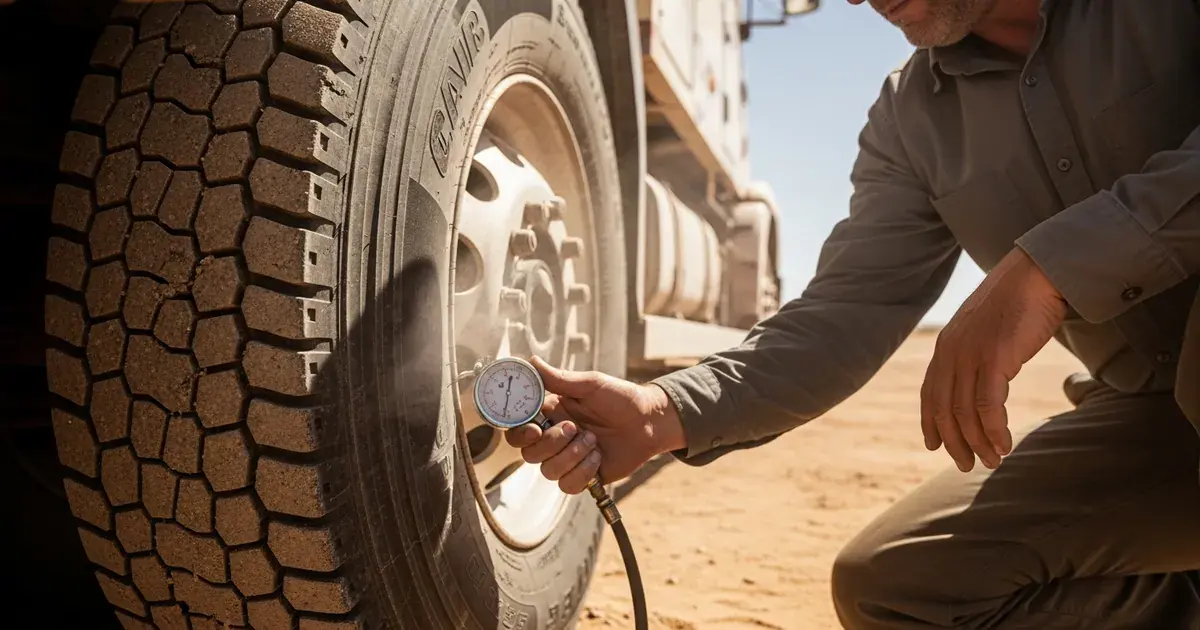
Managing tire pressure in extreme heat is one of the most critical safety practices for commercial truck operators in the Southwest. The relationship between ambient temperature and PSI is governed by precise physics — and getting it wrong can result in catastrophic blowouts, accelerated wear, and DOT violations. This guide provides the PSI guidelines every trucker needs for safe desert operations.
Understanding the Temperature-Pressure Relationship
The fundamental principle governing tire pressure and temperature is Gay-Lussac's Law: as temperature increases, the pressure of a contained gas increases proportionally. For commercial truck tires, the ambient temperature coefficient means that for every 10°F increase in ambient temperature, tire pressure increases by approximately 1 to 2 PSI. On a summer day in Kingman where temperatures swing from 75°F at dawn to 115°F by mid-afternoon, your tires can gain 4 to 8 PSI from temperature alone — before you even add the heat generated by driving.
The Tire and Rim Association (TRA) publishes load and inflation tables that define the maximum load a tire can carry at specific inflation pressures. These tables are the foundation of proper tire pressure management. Every commercial tire has a maximum rated pressure stamped on the sidewall, and operating above that pressure creates risk of casing failure. Operating below the recommended pressure for your load creates excessive heat buildup through increased tire flexion.
Cold Inflation Pressure: The Only Accurate Measurement
Cold inflation pressure is the only meaningful tire pressure measurement. The term "cold" means the tire has not been driven for at least three hours or has been driven less than one mile. In the desert Southwest, this practically means checking tire pressure in the early morning before sunrise, when ambient temperatures are at their daily minimum.
Setting tire pressure during the heat of the day introduces significant error. If you check tires at 2:00 PM when the ambient temperature is 112°F and the tire has been sitting in direct sunlight, the reading will be artificially elevated by 5 to 10 PSI above what it would read at 6:00 AM. If you then reduce pressure to match the specification, you have actually underinflated the tire — and underinflation in extreme heat is the single most common cause of tire failure.
The correct procedure is to set all tire pressures to specification during the early morning cold check. Do not adjust pressure during the day to compensate for heat-induced increases. The pressure increase from heat is normal and expected — the tire is designed to operate safely at those elevated pressures as long as the cold inflation pressure was set correctly.
PSI Guidelines by Tire Position
Different tire positions on a commercial vehicle have different load requirements and therefore different pressure specifications. Steer tires typically operate at 100 to 120 PSI depending on the tire size and axle rating. These tires carry the heaviest per-tire load and have the most critical role in vehicle control. Steer tire pressure must be precise — even a 5 PSI deviation from specification can cause uneven wear and compromised handling.
Drive tires generally operate at 85 to 110 PSI depending on the tandem axle configuration and load distribution. Drive tires in dual assemblies must be matched within 5 PSI of each other. A pressure imbalance between paired duals causes the higher-pressure tire to carry more load and the lower-pressure tire to flex more, creating a compounding failure condition in extreme heat.
Trailer tires typically run at 100 to 110 PSI for standard applications. Trailer tire pressure is often neglected because the driver does not feel trailer tire issues through the steering wheel. This neglect is dangerous — trailer tire failures at highway speed can cause loss of trailer control and jackknifing.
TPMS: Your Real-Time Safety System
A Tire Pressure Monitoring System (TPMS) is the most valuable investment a fleet or owner-operator can make for desert operations. Modern TPMS systems use sensors mounted on each tire valve stem or banded to the wheel rim that transmit real-time pressure and temperature data to an in-cab display. The driver receives immediate alerts when any tire drops below a preset threshold or when temperature exceeds safe limits.
TPMS transforms tire management from a once-daily check to continuous monitoring. A slow leak that might go undetected for hours during a long desert haul is caught within minutes by TPMS. A tire that is building excessive heat from an alignment problem or a dragging brake is flagged before the temperature reaches the failure point. For trucks regularly operating in temperatures above 100°F, TPMS is not a luxury — it is essential safety equipment.
When configuring TPMS alert thresholds for desert operations, set the low-pressure alert at 10 percent below the cold inflation target. Set the high-temperature alert at 158°F — above this temperature, the tire's structural integrity begins to degrade. Some advanced TPMS systems allow setting differential alerts that flag when paired dual tires diverge by more than 5 PSI.
Heat Buildup: The Invisible Killer
Every revolution of a truck tire generates heat through hysteresis — the energy lost as the tire rubber deforms and recovers at the contact patch. Under normal conditions, this heat dissipates into the surrounding air fast enough to maintain equilibrium. In extreme desert heat, the dissipation equation breaks down because the ambient air temperature is already close to the tire's operating temperature.
The heat buildup rate accelerates exponentially with underinflation. A tire that is 10 percent underinflated generates roughly 15 percent more heat per mile than a properly inflated tire. At 20 percent underinflation, heat generation increases by approximately 30 percent. In 115°F ambient conditions, this additional heat can push internal tire temperatures past 250°F — well above the point where rubber compounds begin to break down and steel belt adhesion weakens.
Speed compounds the heat problem. Higher speeds mean more revolutions per minute, more hysteresis cycles, and more heat generation. On hot days, consider reducing speed by 5 to 10 mph below your normal cruising speed. The time lost is insignificant compared to the cost of a high-speed blowout.
Nitrogen Inflation for Desert Operations
Some fleets and owner-operators use nitrogen inflation instead of compressed air. Nitrogen offers several advantages in extreme heat environments. Nitrogen molecules are larger than oxygen molecules, which means nitrogen-filled tires lose pressure more slowly through the tire's molecular structure. Nitrogen is also a dry gas — it contains no moisture that could contribute to internal corrosion or pressure variability as moisture changes phase with temperature.
The practical benefit of nitrogen inflation in desert operations is more stable pressure over time. A tire filled with compressed air may lose 1 to 2 PSI per month through normal permeation. A nitrogen-filled tire typically loses 0.5 to 1 PSI per month. In an environment where every PSI matters for heat management, this stability is meaningful.
However, nitrogen is not a substitute for proper pressure management. You must still check cold inflation pressure regularly, and you must still address any tire that is losing pressure faster than the normal permeation rate.
Pre-Trip Tire Inspection for Desert Routes
Before heading into the desert, perform an enhanced tire inspection beyond the standard pre-trip check. Verify cold inflation pressure on all positions using a calibrated gauge — do not rely on the thump test. Inspect all tire sidewalls for cracking, checking, or weathering damage from UV exposure. Check tread depth on all positions — minimum 4/32 inch on steer tires and 2/32 inch on drive and trailer tires, but we recommend 6/32 and 4/32 respectively for desert operations. Verify that all valve caps are in place and valve stems are not cracked or deteriorated. Inspect dual tire assemblies for proper spacing — debris trapped between duals causes heat buildup and tire damage.
Emergency Tire Pressure Loss on the Highway
If you experience sudden pressure loss while driving in desert heat, do not slam on the brakes. Grip the steering wheel firmly, gradually reduce speed, activate your hazard lights, and steer to the shoulder. A steer tire blowout requires firm, controlled steering input to maintain lane position. A drive tire blowout may cause the truck to pull toward the side of the failure.
Once stopped safely, set out warning triangles and call for mobile tire repair. Do not attempt to change a commercial truck tire in extreme heat without proper equipment — the combination of heavy tire weight, hot pavement, and physical exertion in 115°F heat creates a serious risk of heat-related illness.
For more information on how extreme temperatures affect your tires, read our guide on how extreme heat affects heavy-duty tires.
For 24/7 mobile tire service in the desert Southwest, call Weldon's Truck & Trailer at (334) 759-7020. We carry steer, drive, and trailer tires in common sizes and respond quickly throughout our service area.