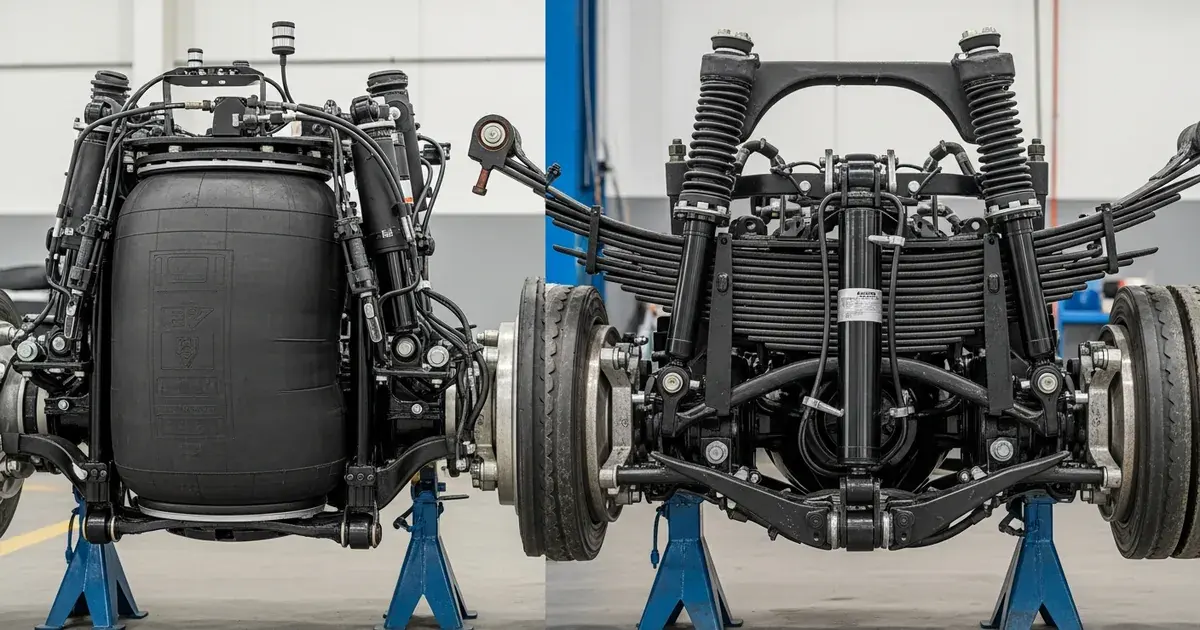
The choice between air suspension and leaf spring suspension is one of the most significant spec decisions for commercial truck and trailer buyers. Each system has distinct advantages and trade-offs that affect ride quality, cargo protection, maintenance costs, driver comfort, and total cost of ownership. Understanding how each system works and how it performs under real-world conditions helps you make the right choice for your specific operation.
How Leaf Spring Suspension Works
Leaf spring suspension is the oldest and most proven suspension design in commercial vehicles. A leaf spring pack consists of multiple layers of tempered steel strips (leaves) bound together by a center bolt and secured by clips. The longest leaf — the main leaf — has rolled eyes at each end that attach to the frame through spring pins and shackles.
When the wheel hits a bump, the spring pack flexes, absorbing the impact energy and releasing it gradually. The inter-leaf friction between the individual leaves provides a natural damping effect that reduces oscillation. A spring hanger at the front and a shackle at the rear allow the spring to change its effective length as it flexes, accommodating the arc of deflection.
The simplicity of leaf springs is their greatest strength. There are no airlines to leak, no air bags to rupture, no ride height valves to malfunction, and no compressor to fail. A leaf spring suspension requires only the spring pack, U-bolts, shackles, spring pins, and optionally shock absorbers. This simplicity translates directly to lower initial cost, lower maintenance cost, and greater reliability in harsh environments.
How Air Suspension Works
Air suspension replaces the steel spring with an air spring — a reinforced rubber bag inflated to a specific pressure by the truck's air system. A ride height valve connected to the axle by a linkage arm automatically adjusts air pressure to maintain proper ride height regardless of load. When the truck is loaded, the valve adds air to compensate for the increased weight. When the truck is unloaded, the valve releases air to prevent over-extension of the suspension.
The air bag provides a progressive spring rate — it becomes stiffer as it compresses and softer as it extends. This progressive characteristic means the suspension self-adjusts its stiffness to match the load, providing a smoother ride across the full load range. An empty truck on air ride is noticeably more comfortable than an empty truck on leaf springs because the air springs are soft enough to absorb small road imperfections.
An equalizer beam connects the tandem axles in a tandem axle air suspension setup, distributing loads evenly between the two axles as the truck travels over uneven surfaces. The ride height sensor on each air bag position monitors and maintains proper ride height, ensuring consistent clearance and handling characteristics.
Ride Quality and Driver Comfort
Air suspension wins the ride quality comparison decisively. The progressive spring rate and the ability to maintain consistent ride height regardless of load provide a noticeably smoother ride that reduces driver fatigue on long hauls. Studies have shown that drivers on air ride suspension experience less back pain, less vibration-induced fatigue, and better alertness than drivers on leaf spring suspension.
Leaf spring suspension provides a firmer, more direct ride. Under full load, the ride quality of a well-designed leaf spring suspension approaches that of air ride because the spring is operating in its designed deflection range. However, when lightly loaded or empty, leaf springs can be quite harsh, transmitting road impacts directly to the frame and cab.
Cargo Protection
Air suspension provides superior cargo protection due to its ability to isolate the cargo from road shocks. Fragile freight, electronics, and damage-sensitive commodities benefit from the reduced vibration and impact forces of air ride. Many shippers require air ride equipment for certain commodities, and some shipping contracts specify air ride suspension as a requirement.
Leaf spring suspension transmits more road shock to the cargo, which can cause product damage, shifted loads, and increased claims rates. For general freight that is not particularly damage-sensitive — steel coils, lumber, construction materials — leaf springs are perfectly adequate. But for high-value or fragile freight, the cargo damage reduction from air ride often justifies the higher initial cost.
Maintenance and Durability Comparison
Leaf spring suspension maintenance is straightforward. Inspect spring packs for broken leaves, shifted centers, and worn shackle pins and bushings. U-bolt torque should be checked at every PM interval because loose U-bolts allow the spring to shift on the axle, causing alignment problems. Spring shackle bushings and pins wear over time and require periodic replacement. Shock absorbers, if equipped, should be inspected for leaks and loss of damping.
Air suspension maintenance is more complex and involves more components. Air bags must be inspected for cracks, cuts, and abrasion damage. The ride height valve linkage must be properly adjusted and free-moving. Air lines and fittings must be inspected for leaks. The air compressor must maintain adequate output to supply the suspension system along with the brake system. Shock absorbers are essential on air ride systems because air springs have minimal inherent damping.
In extreme environments like the desert Southwest, air bags are subjected to intense UV radiation and heat cycling that accelerate rubber degradation. A leaf spring pack may last 500,000 to 700,000 miles in moderate service, while air bags in desert service may require replacement at 200,000 to 300,000 miles.
Cost Comparison
Leaf spring suspension has a lower initial cost — approximately $2,000 to $4,000 less per axle than comparable air ride equipment. Maintenance costs are also lower, with fewer components to inspect and replace. Parts are inexpensive and universally available.
Air ride suspension's higher initial and maintenance costs are offset by reduced cargo damage claims, better driver retention from improved ride quality, and potentially longer tire life from more consistent load distribution. For fleets hauling damage-sensitive freight, the return on the air ride investment is typically positive.
For professional brake and suspension repair service for both air ride and leaf spring systems, call Weldon's Truck & Trailer at (334) 759-7020. Our technicians service both suspension types and can help you evaluate which system best fits your operation.