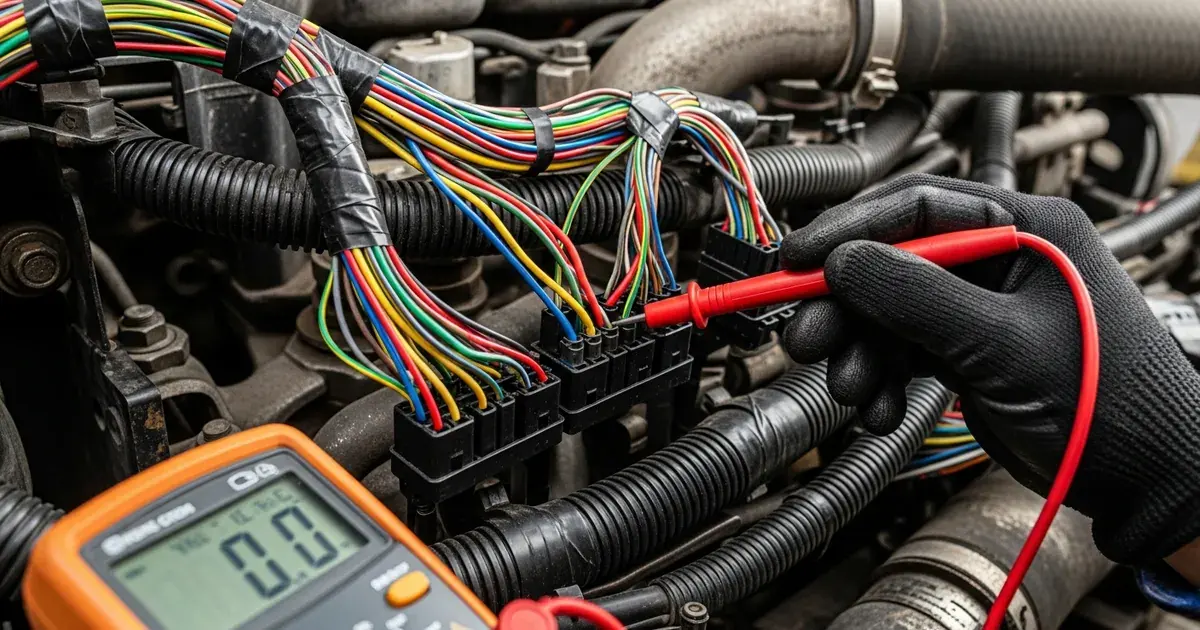
Electrical problems in commercial trucks are among the most difficult to diagnose and the most frustrating to live with. Intermittent failures, phantom warning lights, dead batteries, and mysterious shorts can turn a reliable truck into a constant headache. Understanding how truck electrical systems work and how to systematically diagnose problems saves time, money, and frustration.
The Three-Circuit Foundation
Every truck electrical system is built on three fundamental circuits: the starting circuit, the charging circuit, and the accessory circuits. The starting circuit includes the battery, starter motor, ignition switch, and associated wiring. The charging circuit includes the alternator, voltage regulator, and battery charge wiring. Accessory circuits power everything else — lights, instruments, the ECM, ABS, and all electronic systems.
Most electrical problems fall into one of three categories: open circuits where the path is broken, short circuits where current flows through an unintended path, and high-resistance connections where the path exists but is partially blocked. Understanding which category your problem falls into determines the diagnostic approach.
Systematic Diagnosis: Starting With the Battery
Every electrical diagnosis should begin at the battery. A truck's electrical system cannot function properly with a weak or failing battery, and a bad battery can mask or mimic other problems. Perform a load test on the battery before chasing any other electrical issue. The battery should maintain at least 9.6 volts under load for 15 seconds. If it drops below this threshold, replace the battery before doing any other diagnosis.
Check battery cable connections at both ends — at the battery terminals and at the frame ground and starter. Corrosion, loose connections, and damaged cables create high-resistance connections that cause starting problems, charging issues, and erratic electronic behavior. Clean all connections to bright metal, apply dielectric grease, and torque fasteners to specification.
Alternator Output Testing
If the battery tests good but keeps going dead, the charging system is the next suspect. Test the alternator output with a multimeter while the engine is running. At idle, the alternator should produce 13.8 to 14.4 volts at the battery terminals. At elevated RPM, voltage should remain stable and not exceed 14.8 volts. Current output should meet or exceed the alternator's rated capacity when accessories are loaded.
If voltage is low, check the alternator drive belt for slippage, the wiring between the alternator and battery for resistance, and the voltage regulator function. Many modern trucks have the voltage regulator integrated into the ECM, which adds a layer of electronic complexity to charging system diagnosis.
Parasitic Draw Testing
A parasitic draw is a circuit that continues to consume battery power when the truck is off. Normal parasitic draw for a modern truck with an ECM and ELD is typically 50 to 85 milliamps. Draws exceeding 100 milliamps will drain a battery overnight. Draws above 200 milliamps can kill a battery in a few hours.
To test for parasitic draw, connect a milliamp meter in series with the battery negative cable with the truck off and all accessories closed. Wait 30 minutes for all modules to go to sleep, then read the draw. If it is excessive, begin pulling fuses one at a time to identify which circuit is drawing power. When the draw drops to normal, you have found the offending circuit.
Wiring Harness Damage
The wiring harness is the nervous system of the truck. Physical damage from vibration, chafing, heat, rodent damage, and improper previous repairs is a common source of electrical problems. Inspect harness routing for areas where wires rub against frame members, engine components, or sharp edges. Look for heat-damaged insulation near exhaust components and engine blocks.
A damaged wiring harness can cause intermittent problems that are extremely difficult to reproduce. A wire with damaged insulation may short to ground only when the truck hits a bump or when temperature changes cause the wire to shift position. These intermittent shorts are the most challenging electrical problems to diagnose because they do not show consistent symptoms.
ECM and Engine Control Diagnostics
Modern truck engines are controlled by the Engine Control Module, which monitors dozens of sensors and controls fuel injection, emissions systems, and engine protection features. When the ECM detects a problem, it stores a diagnostic trouble code and may illuminate the check engine light or trigger an engine derate.
Reading ECM fault codes requires a diagnostic scanner compatible with the engine manufacturer's protocol. Our service trucks carry multi-brand scanners that read codes from Cummins, Detroit Diesel, PACCAR, and Navistar engines. However, fault codes are starting points, not final diagnoses. A code for a sensor failure may indicate a bad sensor, a wiring problem, or a connector issue. Proper diagnosis requires testing the entire circuit, not just replacing the component named in the code.
Fuse Panel and Circuit Breaker Issues
Blown fuses and tripped circuit breakers are symptoms, not causes. When a fuse blows, something in that circuit is drawing excessive current. Simply replacing the fuse without finding the underlying cause will result in repeated fuse failures or, worse, a wiring fire if someone installs an oversized fuse.
When diagnosing a blown fuse, use a test light or multimeter to check for a short to ground on the circuit's wiring before installing a new fuse. A short to ground will show as continuity between the circuit wire and the chassis. Trace the circuit until you find where the insulation is damaged or where a component has failed internally.
Ground Fault Problems
Poor ground connections cause more electrical problems than many technicians realize. Every circuit must have a clean, tight connection to chassis ground for proper operation. Corroded, loose, or missing ground connections cause erratic gauge readings, dim lights, slow starter cranking, and false fault codes in electronic systems.
Check every ground connection point on the truck, including the main battery ground, engine ground strap, cab ground points, and frame ground connections. Clean all ground points to bare metal, reinstall fasteners with anti-corrosion compound, and verify continuity with a multimeter.
For professional electrical diagnosis and repair, call Weldon's Truck & Trailer at (334) 759-7020. Our mobile technicians carry diagnostic equipment for all major truck electrical systems and can troubleshoot even the most challenging wiring issues at your location.