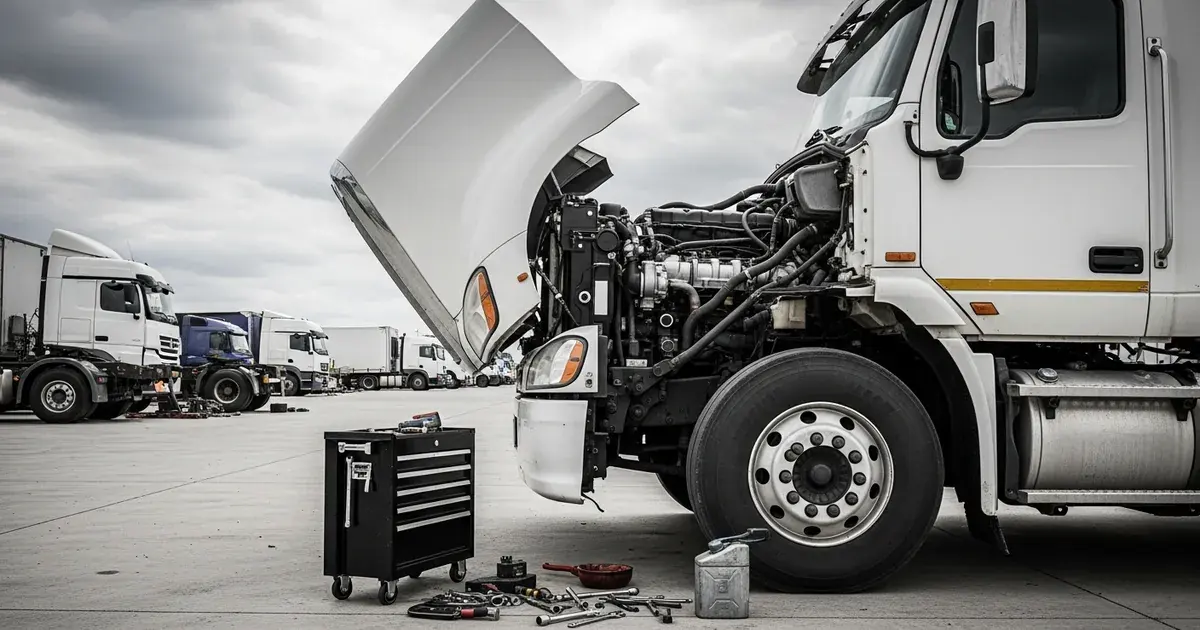
Every fleet manager and owner-operator knows that a truck sitting idle is a truck losing money. But most underestimate the true cost of unplanned downtime because they only count the direct repair bill. The reality is that the repair cost is typically the smallest component of the total downtime expense. When you factor in lost revenue, towing, driver wages, missed delivery penalties, and cascading schedule disruptions, the true cost of a single unplanned breakdown ranges from $500 to $2,000 per day — and that number grows with each additional day the truck sits.
Breaking Down the True Cost of Downtime
To understand the total cost of ownership impact, consider a typical unplanned breakdown scenario. A truck hauling freight on I-40 blows a turbocharger near Winslow, Arizona. Here is the cascade of costs:
The tow to the nearest qualified repair shop costs $1,200 for the 60-mile heavy-duty tow. The turbocharger replacement parts cost $2,500 and the labor runs $800, for a direct repair cost of $3,300. The repair takes two days because the shop needs to order the turbocharger. During those two days, the driver is on standby at $200 per day, costing $400 in unproductive driver wages. The truck averages 500 miles per day at $2.50 per mile, so the lost revenue is $2,500 for the two days. The missed delivery triggers a $500 service failure penalty from the shipper. The customer service team spends four hours rearranging loads to cover the disabled truck's commitments, costing $200 in administrative time.
The total cost of this single breakdown: $8,100. The repair itself was only $3,300 — less than half the total. The remaining $4,800 was entirely attributable to the fact that the breakdown was unplanned.
Planned vs Unplanned Downtime: The Critical Difference
Planned downtime — scheduling a truck for maintenance during a slow period or over a weekend — costs a fraction of unplanned downtime. When you plan maintenance, you choose the timing to minimize revenue impact. You pre-order parts so they are ready when the truck arrives. You schedule the driver for other duties or rest during the maintenance window. You have no towing costs because the truck drives itself to the service location. You have no missed delivery penalties because loads are planned around the maintenance window.
The same turbocharger replacement performed as planned maintenance would cost the $3,300 for parts and labor, plus perhaps $500 in scheduled downtime if the truck needed to sit for a half day. Total cost: $3,800 — less than half the $8,100 unplanned cost.
How Preventive Maintenance Prevents Breakdowns
A well-designed preventive maintenance program identifies developing problems before they cause failures. The turbocharger in the example above did not fail instantly — it showed warning signs for weeks or months before it let go. Increasing exhaust smoke, decreased power, unusual turbo whine, and elevated exhaust temperatures were all present but went unnoticed because the truck was not receiving regular inspections.
Preventive maintenance catches these developing issues through scheduled oil analysis that detects early signs of bearing wear, turbocharger boost pressure testing during PM inspections, visual inspection of turbocharger housing and piping for oil leaks, and review of ECM fault code history that may show intermittent performance issues.
Identifying a failing turbocharger during a PM inspection allows you to schedule the replacement at a time and place that minimizes downtime cost. The repair itself is the same — but the total cost to the operation is dramatically lower.
Measuring Mean Time Between Failures
Mean time between failures (MTBF) is a key metric for evaluating fleet health and maintenance program effectiveness. Calculate MTBF by dividing total operating miles or hours by the number of unplanned breakdowns in a given period. A higher MTBF indicates a healthier fleet and a more effective maintenance program.
Track MTBF per vehicle and per component category. If you notice one truck's MTBF declining, investigate whether it needs additional maintenance attention. If a particular component category — such as cooling system or electrical — shows declining MTBF across the fleet, your PM program may need to add or increase inspection focus in that area.
Asset Utilization and Its Impact on Profitability
Asset utilization — the percentage of time a truck is generating revenue versus sitting idle — is the single most important profitability metric for fleet operations. A fleet with 95 percent asset utilization generates dramatically more revenue per truck than a fleet at 85 percent utilization, even if the 85 percent fleet has lower per-mile operating costs.
Unplanned downtime is the primary destroyer of asset utilization. Each breakdown removes a truck from revenue service for days, and the cascading effect on the schedule may reduce utilization for other trucks in the fleet as well. A PM program that prevents unplanned breakdowns directly protects asset utilization and, by extension, profitability.
Building the Business Case for PM Investment
Preventive maintenance is not free — it requires investment in scheduled downtime, technician time, parts, and program administration. Many fleet operators resist increasing PM spending because they see it as a cost rather than an investment. The business case for PM investment is straightforward when you compare the two scenarios.
Without a PM program, a 10-truck fleet averaging two unplanned breakdowns per truck per year at an average total cost of $5,000 per incident spends $100,000 annually on unplanned breakdown costs. With a comprehensive PM program costing $2,000 per truck per year — $20,000 for the fleet — unplanned breakdowns drop by 60 percent. The reduced breakdown cost is $40,000 per year, saving $60,000 annually after the PM program investment. The return on investment is 300 percent in the first year.
Cost Per Mile Tracking
Track your total maintenance cost per mile, broken down into planned and unplanned categories. A healthy fleet should see planned maintenance costs of $0.08 to $0.15 per mile, unplanned maintenance costs of $0.03 to $0.06 per mile, and a planned-to-unplanned ratio of at least 3:1.
If your unplanned cost per mile exceeds your planned cost per mile, your PM program needs significant improvement. The goal is to shift as much maintenance spend as possible from the unplanned category — where it creates maximum disruption — to the planned category where its impact on operations is minimized.
Starting a PM Program
For fleet operators without a current PM program, the first step is establishing a baseline. Document the current condition of every vehicle in the fleet through a comprehensive inspection. This baseline identifies deferred maintenance that must be addressed before the PM program can be effective. Then establish PM intervals based on manufacturer recommendations adjusted for your operating environment and begin regular scheduled maintenance.
For professional fleet maintenance programs that reduce downtime and protect profitability, call Weldon's Truck & Trailer at (334) 759-7020. We build custom PM programs designed for your fleet's specific operating conditions and budget.