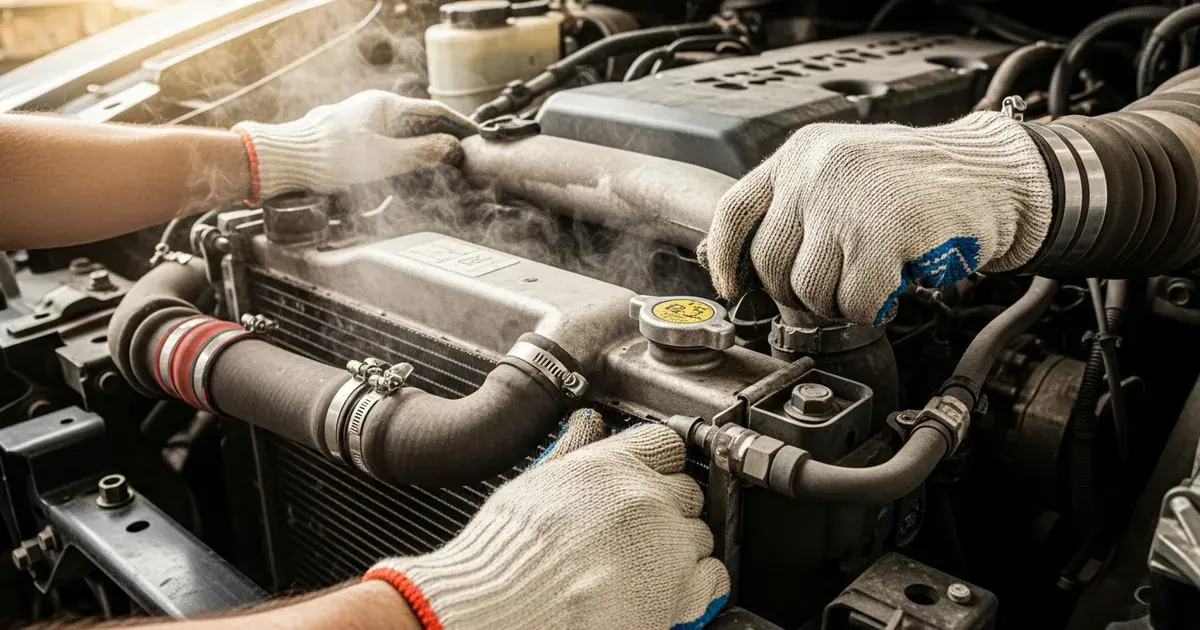
Engine overheating is the third most common cause of roadside breakdowns for commercial trucks, and in the desert Southwest, it moves to first or second during the summer months. When ambient temperatures reach 120°F and pavement radiates heat from below, a truck's cooling system operates at the absolute edge of its design capacity. A single marginal component — a partially blocked radiator core, a weak thermostat, a water pump with worn impeller vanes — can tip the system from adequate cooling to catastrophic overheating. Understanding every component of the cooling system and maintaining each one proactively is the only reliable way to prevent overheating in extreme desert heat.
How the Cooling System Works Under Extreme Heat
The cooling system removes waste heat from combustion by circulating coolant through passages in the engine block and cylinder head, then passing the heated coolant through the radiator core where airflow strips the heat away. The thermostat regulates coolant flow to maintain optimal engine operating temperature, and the water pump provides the circulation force to move coolant through the system.
In moderate 80°F ambient conditions, the cooling system has significant reserve capacity. The radiator can reject more heat than the engine produces, and the thermostat modulates the flow to prevent overcooling. In 120°F desert conditions, this reserve capacity shrinks dramatically. The temperature differential between the coolant and the ambient air — the driving force for heat rejection — is cut nearly in half. The radiator must work much harder to reject the same amount of heat, and any deficiency in the system immediately manifests as rising coolant temperature.
Extended Life Coolant: Desert Specifications
Modern diesel engines use extended life coolant (ELC) formulations that provide corrosion protection for 600,000 to 800,000 miles under normal conditions. ELC eliminates the need for supplemental coolant additive (SCA) additions at PM intervals, simplifying maintenance. However, desert conditions degrade even ELC faster than moderate climates.
The critical specification for desert operation is the coolant concentration. Coolant should be maintained at a 50/50 to 60/40 ratio of antifreeze to water. While 50/50 provides the best heat transfer efficiency, increasing to 60/40 provides better high-temperature boiling protection at a small cost in heat transfer efficiency. In desert operations where the risk of boil-over exceeds the risk of overcooling, the 60/40 ratio is often preferred.
Test coolant concentration at every PM interval using a refractometer — not a float-type hydrometer, which is less accurate. Also test coolant pH — it should remain between 8.0 and 10.5 for conventional coolants and within the manufacturer's specification for ELC formulations. Low pH indicates the coolant's corrosion inhibitor package is depleted, exposing internal cooling system surfaces to corrosion that can block coolant passages and reduce heat transfer.
Supplemental Coolant Additive Management
For engines using conventional coolant rather than ELC, supplemental coolant additives are critical for protecting internal surfaces from cavitation erosion and corrosion. SCA must be maintained at the correct concentration — too little provides inadequate protection, while too much can create gel-like deposits that block coolant passages and radiator tubes.
Test SCA concentration at every oil change interval. Add SCA through a coolant filter (spin-on type with SCA pre-charge) for consistent dosing. If the SCA level is found to be excessive, the coolant may need to be partially drained and replaced with fresh coolant to bring the concentration back into range.
Thermostat: The Temperature Gatekeeper
The thermostat controls coolant flow between the engine and the radiator. A properly functioning thermostat remains closed during engine warm-up, allowing the engine to reach operating temperature quickly, then opens at the rated temperature to allow coolant to flow through the radiator.
Thermostat failures take two forms. A thermostat stuck closed prevents coolant from reaching the radiator, causing rapid overheating. This failure is dramatic and obvious — the temperature gauge climbs quickly and the truck overheats within minutes. A thermostat stuck partially open or stuck open allows coolant to flow to the radiator continuously, preventing the engine from reaching optimal operating temperature. While this does not cause overheating, it reduces engine efficiency, increases fuel consumption, and can cause excessive wear from operating below optimal temperature.
Test the thermostat by monitoring the coolant temperature during warm-up. The temperature should rise steadily to the thermostat's rated opening temperature, then stabilize. If the temperature climbs past the rated opening temperature without stabilizing, the thermostat is not opening properly. If the temperature never reaches the rated level, the thermostat is stuck open.
In desert operations, some drivers remove the thermostat entirely to prevent overheating. This is counterproductive — without a thermostat, coolant flows through the radiator too quickly, reducing the time available for heat transfer. The radiator actually works less efficiently without a thermostat, and the engine may still overheat under heavy load because the coolant passes through the radiator too fast to shed its heat.
Water Pump Inspection and Testing
The water pump circulates coolant through the entire system. A failing water pump reduces flow rate, which reduces the system's ability to move heat from the engine to the radiator. Water pump failures are often gradual — the impeller vanes erode from cavitation, or the shaft bearings wear, reducing pump efficiency over time.
Inspect the water pump weep hole at every PM interval. A small amount of seepage from the weep hole is normal, but a steady drip or stream indicates that the shaft seal has failed. Check the drive belt for proper tension — a loose belt reduces pump speed and can cause the pump to slip under high-load conditions when cooling demand is greatest.
Radiator Core Maintenance
The radiator core is the primary heat exchanger. Its effectiveness depends on clean, unobstructed airflow through the core fins and clean, unobstructed coolant flow through the core tubes. Desert conditions attack both sides of this equation.
External contamination from desert dust, insects, and road debris blocks airflow through the core fins. Clean the radiator core face at every PM interval using low-pressure water or compressed air directed from the engine side outward. Do not use high-pressure water that can bend or flatten the delicate fins — damaged fins block airflow just as effectively as debris.
Internal scale and deposit buildup restricts coolant flow through the radiator tubes. Over time, minerals from the water component of the coolant precipitate on internal surfaces, reducing the effective flow area and insulating the tube walls from heat transfer. A cooling system flush at the manufacturer's recommended interval removes internal deposits and restores heat transfer efficiency.
For professional cooling system service and more guidance, explore our fleet maintenance services and read our guide on cooling system maintenance for commercial trucks.
For emergency cooling system repair and mobile radiator service, call Weldon's Truck & Trailer at (334) 759-7020. We carry radiator hoses, thermostats, water pumps, and coolant for immediate roadside repairs in the desert Southwest.