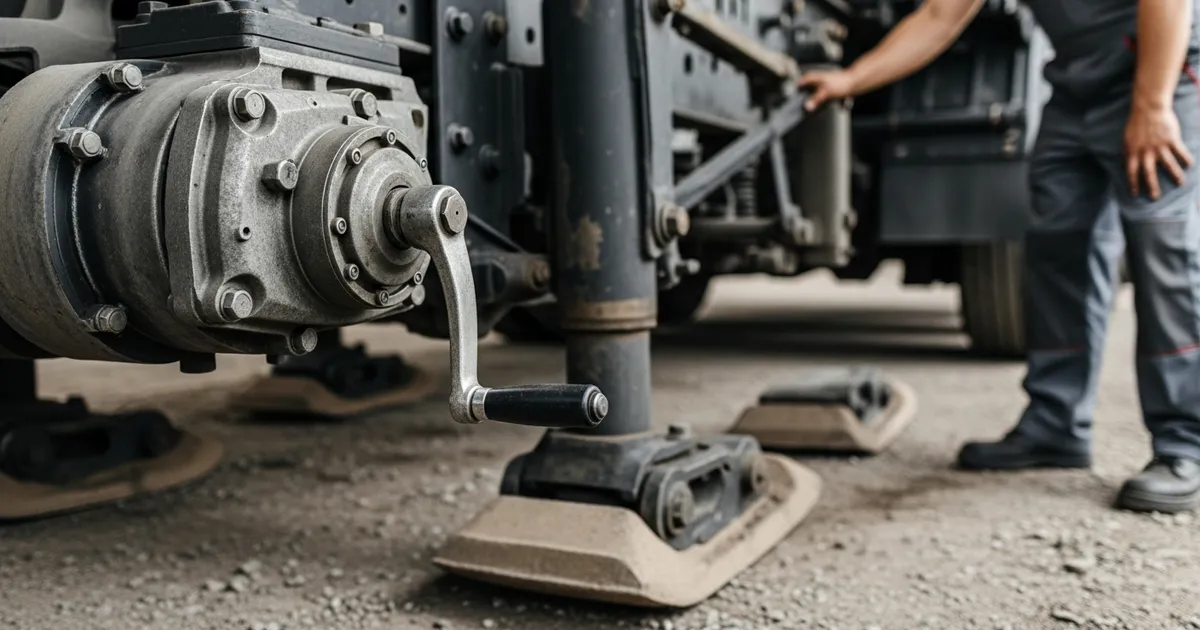
Trailer landing gear is one of the most used and most abused components on a commercial trailer. Every time a trailer is dropped at a dock or picked up for transport, the landing gear must support the full weight of the trailer nose — typically 10,000 to 25,000 pounds depending on the trailer type and load. Over hundreds of coupling and uncoupling cycles, landing gear components wear, bend, corrode, and eventually fail. A landing gear that will not extend, will not retract, or cannot support the trailer's weight creates an immediate operational problem that halts loading, unloading, and trailer movement.
How Landing Gear Works
A standard trailer landing gear assembly consists of two telescoping legs — an outer tube and an inner tube — connected by a gearbox housing at the top. The gearbox contains two speed ranges: high-speed gear for rapid extension and retraction when the legs are unloaded, and low-speed gear for the final positioning when the trailer weight is being transferred to or from the legs.
The cross shaft connects the gearbox assemblies on both sides of the trailer, allowing a single crank handle to operate both legs simultaneously. The crank handle inserts into either end of the cross shaft, and turning the handle drives the gears that raise or lower the legs. A sand shoe — a flat pad at the bottom of each leg — distributes the weight over a larger area to prevent the leg from sinking into soft ground.
The transition between high-speed and low-speed gear is critical. In high speed, the legs move quickly but with relatively low force. In low speed, the legs move slowly but with enough force to lift the trailer nose off the fifth wheel during uncoupling. The driver must shift to low gear before the legs contact the ground — attempting to lower the trailer weight on the high-speed gear will damage the gearbox.
Common Landing Gear Failures
The most frequent landing gear failure is a stripped or damaged gearbox. The gears inside the gearbox housing are subjected to enormous forces during the low-speed lifting operation. When drivers attempt to use high-speed gear to lift the trailer — a common mistake driven by impatience — the smaller high-speed gears cannot handle the load and strip their teeth. Once the gear teeth are damaged, the handle spins freely without moving the legs.
Cross shaft failures are the second most common issue. The cross shaft spans the width of the trailer and is subjected to torsional stress every time the landing gear is operated. Over time, the shaft can twist, bend, or break at stress concentration points — typically at the keyway or at the transition between the shaft and the gearbox input. A broken cross shaft means the crank handle drives only one side, causing the trailer to lower unevenly.
Leg tube corrosion and binding occurs when the inner tube corrodes inside the outer tube, creating friction that prevents smooth extension and retraction. Desert sand and road debris that enter between the tubes accelerate this wear. In severe cases, the inner tube seizes completely inside the outer tube, requiring disassembly and cleaning or complete leg replacement.
Crank handle socket damage is a common minor failure. The square socket that accepts the crank handle rounds out from repeated use, especially when operators use breaker bars or cheater pipes to force stuck landing gear. Once the socket is rounded, the crank handle slips and cannot transmit force to the gears.
Gearbox Housing Repair and Replacement
Gearbox failure requires either rebuild or replacement of the entire gearbox assembly. A rebuild involves disassembling the housing, inspecting all internal gears, bearings, and shafts, replacing damaged components, reassembling with proper lubrication, and verifying smooth operation through both gear ranges.
Gearbox replacement is often more cost-effective than rebuild because aftermarket replacement gearboxes are readily available at reasonable cost, and the labor time for replacement is less than for rebuild. When replacing a gearbox, verify that the replacement unit matches the original's gear ratio, mounting pattern, and shaft size.
Cross Shaft Diagnosis and Replacement
A damaged cross shaft produces specific symptoms. If the cross shaft is twisted but not broken, the landing gear legs will be at different heights — one side extends or retracts faster than the other, causing the trailer to tilt. If the cross shaft is broken, the crank handle will turn but only one side responds.
Cross shaft replacement requires supporting the trailer on blocks or a tractor fifth wheel, removing the old shaft from both gearbox assemblies, sliding the new shaft into position, ensuring proper keyway alignment on both sides, and testing operation through both gear ranges.
Sand Shoe and Foot Pad Issues
The sand shoe at the bottom of each landing gear leg distributes weight to prevent the leg from punching through soft surfaces. In desert operations, sand shoes are essential — without them, the legs can sink into soft shoulders, unpaved yards, and sandy ground surfaces. Damaged or missing sand shoes also reduce the effective bearing area on paved surfaces, concentrating load on a small point.
Inspect sand shoes for cracks, bends, and wear at every trailer PM. Replace sand shoes that are bent more than 10 degrees from flat or that have visible cracks. Sand shoe replacement is typically a bolt-on procedure — remove the existing mounting bolts, install the new shoe, and torque to specification.
Preventive Maintenance for Landing Gear
Lubrication is the most important preventive maintenance for landing gear longevity. Grease the gearbox input shaft, the cross shaft bearings, and the leg tube guides at every PM interval. Apply a light coating of grease to the inner leg tubes to prevent corrosion and reduce friction. Operate the landing gear through both gear ranges during PM to verify smooth operation and identify developing problems.
Check the gearbox mounting hardware — the bolts that secure the gearbox to the trailer frame. These bolts carry the full nose weight of loaded trailers and can loosen from vibration. Retorque to specification at every PM interval.
Emergency Landing Gear Solutions
When landing gear fails at a dock or in a yard, several temporary solutions can keep operations moving while repair is arranged. A portable hydraulic trailer jack can raise the trailer nose for coupling or uncoupling when the mechanical landing gear is inoperative. Blocking the trailer nose on hardwood cribbing provides temporary support while the landing gear is repaired. A tractor can hold the trailer nose up while a mobile repair technician works on the landing gear.
For professional landing gear repair and trailer service, including hydraulic repair for hydraulic landing gear systems, call Weldon's Truck & Trailer at (334) 759-7020. Our mobile technicians carry gearbox assemblies, cross shafts, crank handles, and sand shoes for on-site landing gear repair.