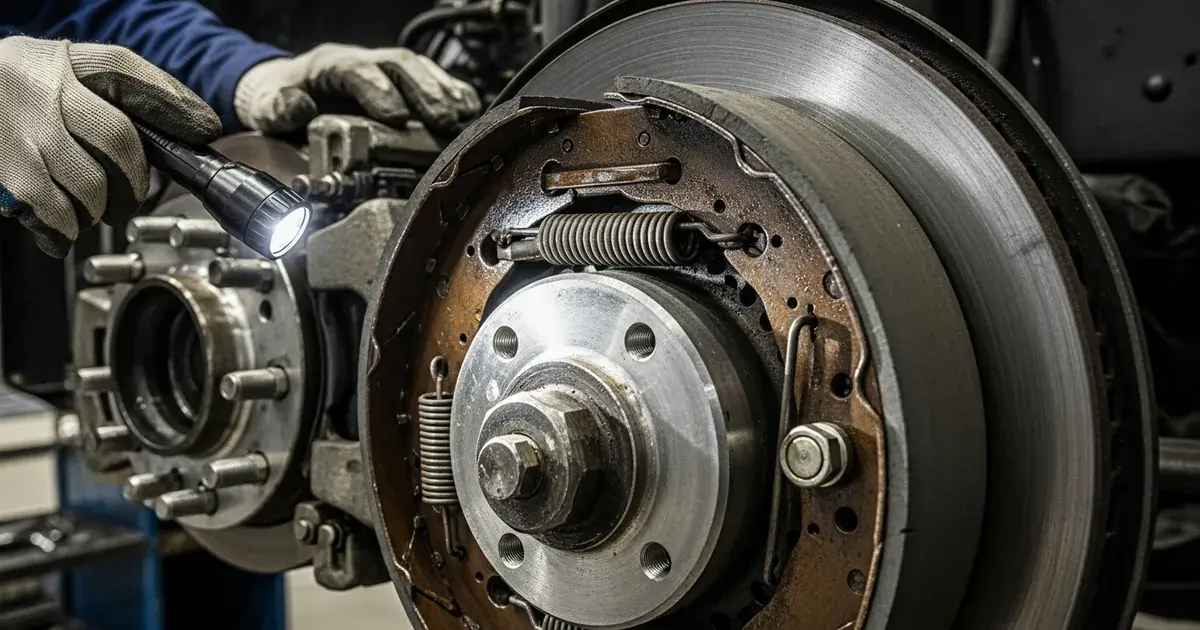
Brake system failures are among the most dangerous and most common issues affecting commercial trucks. According to FMCSA data, brake-related violations are consistently the number one reason trucks are placed out of service during roadside inspections. Understanding the most common semi truck brake problems — and knowing how to address them — can save your life, your cargo, and your career.
1. Out-of-Adjustment Automatic Slack Adjusters
The automatic slack adjuster is designed to maintain proper brake adjustment as foundation brakes wear. However, these mechanisms can fail, leaving brakes out of adjustment and significantly increasing stopping distance. Signs of a failed automatic slack adjuster include excessive pushrod travel — if the pushrod extends more than two inches when brakes are applied, the brake is out of adjustment. A FMCSA inspection will result in an out-of-service violation if brake adjustment exceeds limits.
The fix involves inspecting the slack adjuster mechanism for wear, replacing worn components, and verifying proper adjustment after installation. Never manually adjust an automatic slack adjuster without investigating why it went out of adjustment — the underlying cause must be addressed.
2. Air Brake Chamber Failures
Brake chambers convert air pressure into mechanical force to apply the brakes. Common failures include diaphragm rupture, corrosion of the chamber body, and pushrod seal leaks. A ruptured diaphragm results in complete brake loss on that wheel position, which can create an imbalanced braking condition that leads to jackknifing.
Replacement of the entire brake chamber is typically the best repair approach. Our mobile service trucks carry standard and long-stroke brake chambers in common sizes for immediate roadside replacement.
3. Air System Leaks
The air brake system relies on maintaining consistent air pressure. Leaks in air lines, fittings, gladhand connections, or valves cause the system to lose pressure over time. If the leak is severe enough, the low air pressure warning will activate and spring brakes will apply automatically. Signs of air leaks include the compressor cycling more frequently than normal, audible hissing sounds, and the air pressure gauge dropping when the engine is off.
Finding and repairing air leaks requires a systematic approach. Our technicians perform a complete air system leak-down test, applying soapy water to all connections and checking the entire system from the compressor to the brake chambers.
4. Worn Brake Drums
Brake drums absorb enormous amounts of heat during braking. Over time, the drum's inner surface wears and the drum becomes oversized, reducing braking effectiveness. Heat-cracked drums are especially dangerous because they can fail catastrophically under heavy braking. FMCSA regulations set maximum drum diameter limits — exceeding these limits results in an out-of-service violation.
Drum replacement is the only permanent fix for worn or cracked drums. Our technicians measure drum diameter during brake service to identify drums approaching their service limit before they become a safety hazard.
5. Contaminated Brake Shoes and Linings
Oil, grease, or brake fluid contamination on brake shoes drastically reduces friction and braking power. Contamination typically comes from leaking wheel seals, hub oil seals, or brake chamber pushrod seals. Contaminated brakes often produce a distinct smell and may cause the truck to pull to one side during braking.
Repair involves identifying and fixing the source of contamination, then replacing all affected brake shoes and hardware. Simply cleaning contaminated linings is not acceptable — once contaminated, the friction material is permanently compromised.
6. S-Cam and Bushing Wear
The S-cam rotates when brakes are applied, pushing the brake shoes against the drum. Worn S-cam bushings cause the cam to wobble, resulting in uneven brake application and accelerated shoe wear. Badly worn S-cam bushings also allow the cam to drop, preventing full brake application on that wheel.
S-cam and bushing replacement is straightforward but requires removing the brake components for access. This repair should be combined with a complete brake job including new shoes, hardware, and drums if needed.
7. ABS Sensor Failures
Anti-lock braking system sensors monitor wheel speed to prevent lockup during hard braking. Failed ABS sensors trigger the ABS warning light and disable anti-lock function for the affected wheel. While the base braking system still works, the loss of ABS increases the risk of wheel lockup and loss of control, especially on wet or icy roads.
ABS sensor replacement involves diagnosing which sensor has failed using a diagnostic scanner, then replacing the sensor and clearing the fault codes. Our technicians carry ABS sensors and diagnostic equipment for all major truck systems.
8. Relay Valve Malfunctions
Relay valves control the flow of air to the brake chambers, responding to signals from the brake pedal. A malfunctioning relay valve can cause delayed brake application, uneven braking, or complete brake failure on one or more axles. Signs include one axle braking harder than others, delayed response when pressing the brake pedal, or brakes that drag after releasing the pedal.
Relay valve replacement is the standard repair. Our mobile technicians carry common relay valves and can diagnose and replace them at your location.
9. Spring Brake Problems
Spring brakes serve as the parking brake and as an emergency brake if air pressure is lost. Problems include broken power springs, corroded spring chambers, and frozen release mechanisms. A stuck spring brake can prevent the truck from moving, while a broken spring means no parking brake on that wheel.
Spring brake chamber replacement requires careful handling due to the high-energy spring inside. Our technicians follow proper safety procedures for spring brake service, including using the correct caging tools.
10. Brake Balance Issues
When brakes are not balanced across all axles, the truck stops unevenly. This can cause premature wear on the harder-working brakes, increase stopping distance, and create dangerous handling characteristics. Poor brake balance is often the result of mixing new and worn components, improper adjustment, or uneven air delivery to different axles.
Correcting brake balance requires a complete inspection of all brake components on all axles, including measurement of drum sizes, lining thickness, pushrod travel, and air pressure delivery. Our technicians perform comprehensive brake system evaluations that identify and correct balance issues.
Prevention Through Regular Inspection
The best way to prevent brake problems is through regular inspection and maintenance. A thorough brake inspection should be performed at every preventive maintenance interval, with particular attention to pushrod travel, lining thickness, drum condition, and air system integrity. Fleet operators should track brake component life and replace items proactively before they fail.
For professional brake diagnosis and repair for your semi truck, call Weldon's Truck & Trailer at (334) 759-7020. We provide mobile brake service 24/7 throughout our service area.