Tire replacement is one of the largest recurring expenses for commercial truck operators. A single steer tire costs $300 to $500, and a full set of 18 tires on a tractor-trailer can represent a $5,000 to $8,000 investment. When axle misalignment causes premature tire wear, that investment evaporates thousands of miles before the tires reach their expected service life. Understanding how alignment parameters affect tire wear — and recognizing the warning signs of misalignment — can save thousands of dollars per vehicle per year.
Understanding Alignment Parameters
Commercial vehicle alignment involves three primary parameters: toe, camber, and thrust angle. Each parameter affects tire wear differently, and each has specific measurement standards for commercial vehicles.
Toe is the angle at which the tires point relative to the vehicle's centerline when viewed from above. Toe-in means the fronts of the tires are closer together than the rears — like pigeon-toed stance. Toe-out means the fronts are farther apart. For steer axles, proper toe setting is critical for straight-line tracking and even tire wear. Most commercial trucks specify slight toe-in on the steer axle — typically 1/16 to 1/8 inch total toe — to compensate for the natural tendency of the tires to push outward under load.
Incorrect toe causes the tires to scrub sideways against the road surface with every revolution. This scrubbing generates heat, accelerates tread wear, and creates a distinctive feathered wear pattern where each tread rib develops a sharp edge on one side and a rounded edge on the other. Running your hand across the tread will feel smooth in one direction and rough in the other.
Camber is the inward or outward tilt of the tire when viewed from the front. Positive camber means the top of the tire tilts outward. Negative camber means the top tilts inward. Commercial trucks typically run a small amount of positive camber to compensate for loaded road crown. Excessive camber causes one side of the tread to wear faster than the other — the inside edge wears faster with negative camber, and the outside edge wears faster with positive camber.
Thrust angle is the direction the rear axle or axles are pointing relative to the vehicle's geometric centerline. A non-zero thrust angle means the rear axles are pushing the vehicle at an angle to the centerline, causing the truck to travel in a condition called dog tracking. Dog tracking is visible from behind — the trailer tracks offset from the tractor rather than following directly behind it. This condition causes accelerated tire wear on all axles, increased fuel consumption from the additional aerodynamic drag, and driver fatigue from constant steering correction.
How Misalignment Destroys Tires
The financial impact of misalignment on tire life is dramatic. Industry data shows that a steer axle toe error of 1/4 inch — just 1/8 inch more than typical specification — can reduce tire life by 25 to 30 percent. A steer tire that would normally last 150,000 miles might only last 100,000 miles with this level of misalignment. At $400 per tire, that 50,000-mile reduction costs $4 per 1,000 miles on the steer axle alone.
Drive and trailer axle misalignment has an even broader impact because these axles have dual tires. A tandem drive axle with 1/8-inch toe error on one axle scrubs four tires simultaneously, and the misalignment-induced scrubbing also affects the opposite axle's tracking. The compounding effect can reduce drive tire life by 20 to 40 percent depending on the severity and combination of alignment errors.
Reading Tire Wear Patterns
Tire wear patterns tell the story of what has been happening to the alignment since the last tire change. Learning to read these patterns allows you to identify alignment problems before they consume an entire set of tires.
Feathered wear across the tread ribs indicates a toe problem. The feathering direction tells you whether the toe is in or out. Shoulder wear on one side of the tread indicates camber error — the heavy-wear side corresponds to the direction the tire is tilting. Cupping or scalloping — uneven wear that creates a wavy surface — indicates a combination of misalignment with suspension problems such as worn shocks, loose torque rods, or worn bushings.
Diagonal wear across the tread surface, sometimes called heel-toe wear, indicates a drive or trailer axle tracking problem. This pattern is most visible on trailer tires and is often the first visible sign of a bent axle, shifted spring perch, or worn torque rod bushing.
Laser Alignment Systems
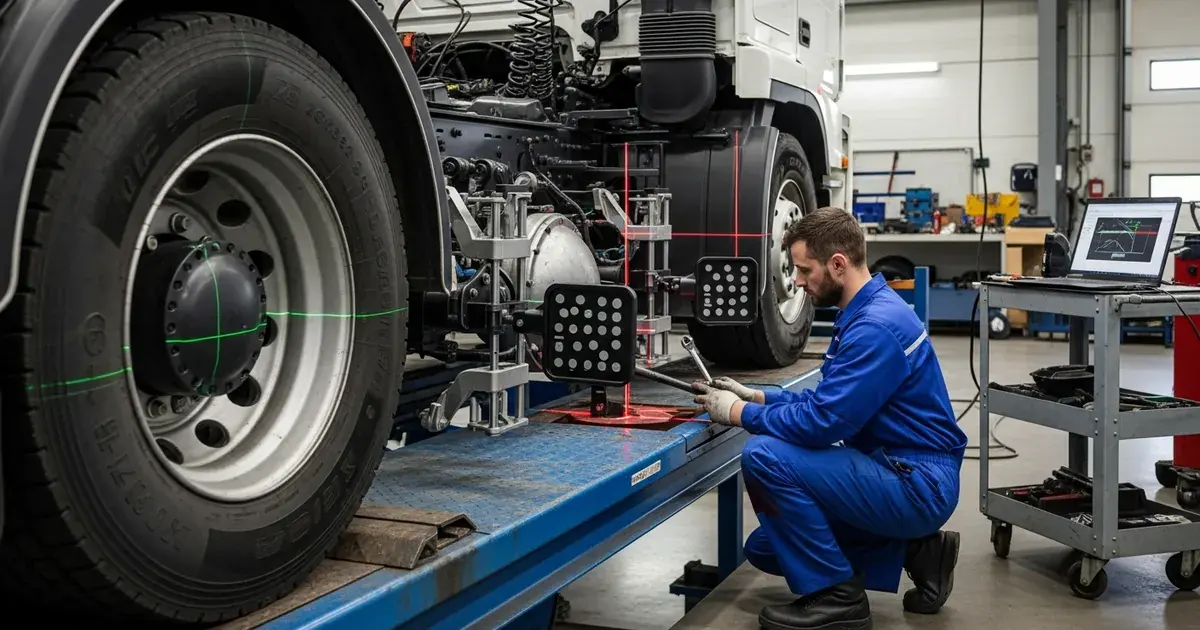
Modern commercial vehicle alignment uses laser alignment systems that measure all alignment parameters simultaneously with high precision. The laser alignment system consists of sensors mounted on each wheel that project and receive laser beams, creating a three-dimensional map of every wheel's position relative to the vehicle's geometric centerline.
A complete laser alignment measurement includes steer axle toe, camber, and caster, individual drive axle toe and camber for each axle in a tandem, tandem axle parallelism (the relationship between the two drive axles), thrust angle, and trailer axle alignment relative to the kingpin centerline.
The laser system displays all measurements simultaneously, allowing the technician to see how adjusting one parameter affects others. This holistic view is essential because alignment parameters are interconnected — adjusting toe on one axle may change the thrust angle, which affects the tracking of all other axles.
When to Check Alignment
Commercial vehicle alignment should be checked at specific intervals and after specific events. Check alignment at every 100,000-mile PM interval as a baseline. Check immediately after hitting a significant pothole, curb, or road hazard. Check after any suspension component replacement — springs, air bags, torque rods, bushings, or axle components. Check when any irregular tire wear pattern appears. Check after any accident or impact, even if no visible damage is apparent.
For trailer axles, alignment should be checked at every annual DOT inspection. Trailer axle alignment is frequently neglected because trailers don't have steering systems, but misaligned trailer axles scrub tires just as aggressively as misaligned steer axles — and trailers typically have more tire positions to wear out.
Alignment and Fuel Economy
Beyond tire wear, misalignment affects fuel economy. A truck that is dog tracking due to rear axle thrust angle error presents a larger frontal area to the wind than a truck tracking straight. The resulting aerodynamic drag increases fuel consumption by 0.5 to 1.5 percent — a meaningful number when diesel costs $4 or more per gallon and a truck travels 100,000 miles per year.
Steer axle misalignment also increases rolling resistance. Tires that are scrubbing sideways against the pavement require more energy to maintain speed. The fuel penalty from steer axle misalignment can add another 0.5 to 1 percent to fuel consumption. Combined with the tire life reduction, misalignment is one of the most expensive maintenance items that fleet operators often overlook.
For professional axle alignment diagnosis and service, and to learn more about axle and bearing repair, see our guide on when to replace vs repair a trailer axle.
For alignment-related tire wear diagnosis and mobile axle service, call Weldon's Truck & Trailer at (334) 759-7020. We help identify alignment issues through tire wear analysis and recommend the appropriate correction.