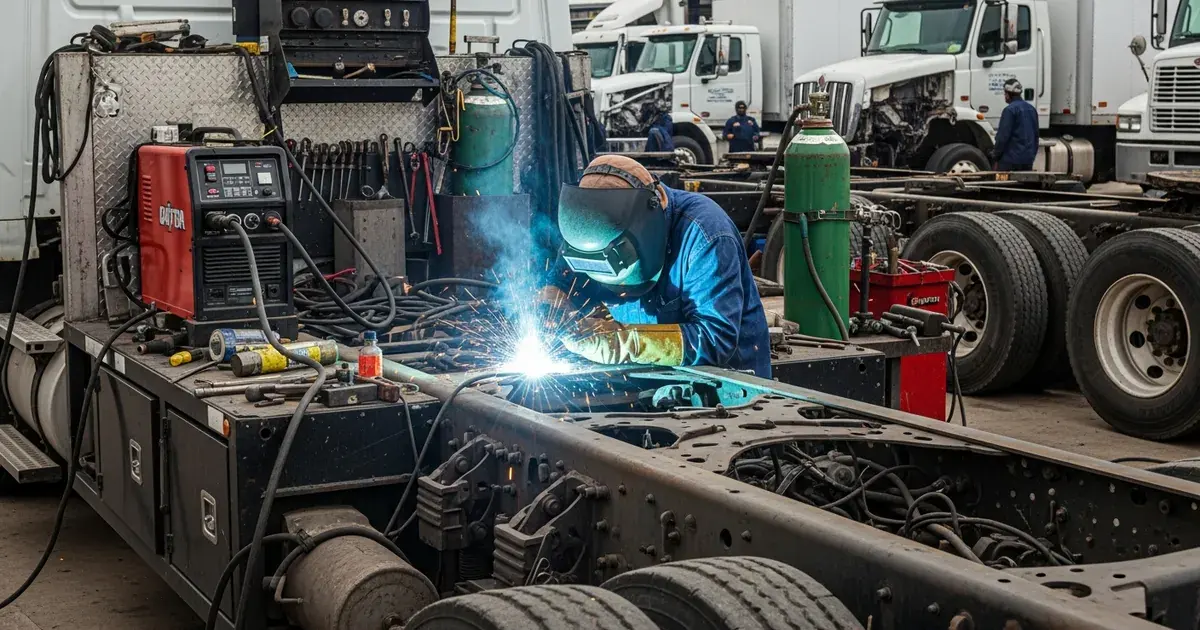
When a trailer crossmember cracks, a frame bracket breaks, or a landing gear mounting plate fails, the traditional repair path involves towing the trailer to a shop, waiting for shop availability, completing the welding repair, and then retrieving the trailer — a process that typically takes two to three days and costs thousands of dollars in towing, shop labor, and lost productivity. Mobile welding eliminates this entire sequence by bringing a fully equipped welding shop to the trailer's location. The result is dramatic cost savings and radically reduced downtime.
The Economics of Mobile Welding
Consider a typical welding repair scenario. A fleet trailer at a shipper's dock has a cracked crossmember that was discovered during a pre-trip inspection. The traditional approach involves calling a tow service to move the disabled trailer from the dock, paying $500 to $1,500 for the tow to the nearest welding shop, waiting 24 to 48 hours for the shop to complete the repair, paying shop labor rates of $125 to $175 per hour plus parts, and then towing or driving the trailer back to service.
The total cost including tow, repair, and lost revenue from the trailer being out of service for two to three days can easily reach $3,000 to $5,000.
With mobile welding, a technician drives to the shipper's dock with a portable welding generator, supplies, and tools. The repair is completed on-site in two to four hours. The trailer never leaves the dock. The total cost is the service call fee plus labor and materials — typically $500 to $1,200 for the same repair. The fleet saves the tow cost, eliminates two to three days of lost trailer productivity, and avoids the logistics of managing a trailer repair at a remote shop.
AWS D1.1 Standards in Field Welding
Quality in mobile welding is measured against the same standards as shop welding. The American Welding Society's D1.1 Structural Welding Code defines the requirements for welding structural steel, including joint preparation, welding technique, preheat and interpass temperature requirements, and inspection criteria.
Our mobile welders follow weld procedure specifications (WPS) that define every parameter of the welding process: the type of filler metal, shielding gas composition, current and voltage settings, travel speed, and preheat requirements. These WPS documents are developed for specific materials and joint configurations and ensure that field welds meet the same structural standards as shop welds.
A common misconception is that field welding is inherently lower quality than shop welding. This is not true when the welder is properly trained and equipped. The critical factors for weld quality — proper joint preparation, correct filler metal selection, adequate shielding gas coverage, and controlled heat input — can all be achieved in the field with the right equipment and technique.
Portable Welding Generator Capabilities
Modern portable welding generators are remarkably capable machines. Our mobile welding units carry multi-process portable welding generators that provide MIG (GMAW) welding for general steel fabrication and repair, stick (SMAW) welding for field conditions where wind makes gas-shielded processes impractical, TIG (GTAW) welding for aluminum and stainless steel applications, and plasma cutting for removing damaged sections and preparing joints.
These generators produce clean, stable welding power that matches or exceeds the quality of fixed shop welding machines. They also provide auxiliary power for grinders, lights, and other tools needed for the repair. A fully equipped mobile welding unit is a complete fabrication shop on wheels.
Common Fleet Welding Repairs
The range of welding repairs performed in the field covers most structural and non-structural trailer and truck body damage. Crossmember crack repair involves grinding out the crack, performing a dye penetrant inspection to verify crack extent, V-grooving the repair area, and welding with proper preheat. Frame bracket repair addresses broken or cracked suspension mounts, landing gear brackets, and body mounting brackets. Floor section replacement patches damaged sections of trailer flooring with new plate. Landing gear mounting plate repair addresses the high-stress mounting area where the landing gear attaches to the trailer frame.
Door hinge and latch welding restores door hardware function without replacing entire door assemblies. Bumper and underride guard repair addresses DOT-mandated rear impact guard (ICC bumper) damage from dock impacts or road incidents. Side rail and rub rail repair fixes damage from loading dock contacts and tight maneuvering.
When Field Welding Is Not Appropriate
Not every welding repair should be performed in the field. Some situations require shop-level equipment and conditions. Repairs that require post-weld heat treatment should be performed in a shop with proper furnace equipment. Welding on high-strength alloy steels that require precise preheat and interpass temperature control may be better suited to shop conditions. Repairs in locations where wind, rain, or contamination cannot be adequately controlled should wait for shop conditions. Extensive structural damage that requires jigging, alignment fixtures, or frame straightening equipment must be performed in a shop.
Our technicians evaluate every repair situation honestly. If a repair should be performed in a shop rather than in the field, we will tell you — and help coordinate the shop repair to minimize your downtime.
Fleet Welding Maintenance Programs
For fleet operators, a proactive welding inspection program catches structural problems before they become emergency repairs. Include structural welding inspection in your trailer PM program. Look for cracks at high-stress points — crossmember-to-main-rail joints, landing gear mounts, suspension brackets, and body mounting hardware. Cracks caught early can be repaired in minutes. The same crack left until it propagates may require extensive structural repair costing ten times more.
For professional mobile welding and trailer repair services, and fleet maintenance programs that include structural inspection, call Weldon's Truck & Trailer at (334) 759-7020. Our mobile welding units respond 24/7 with the equipment and expertise for quality field repairs.