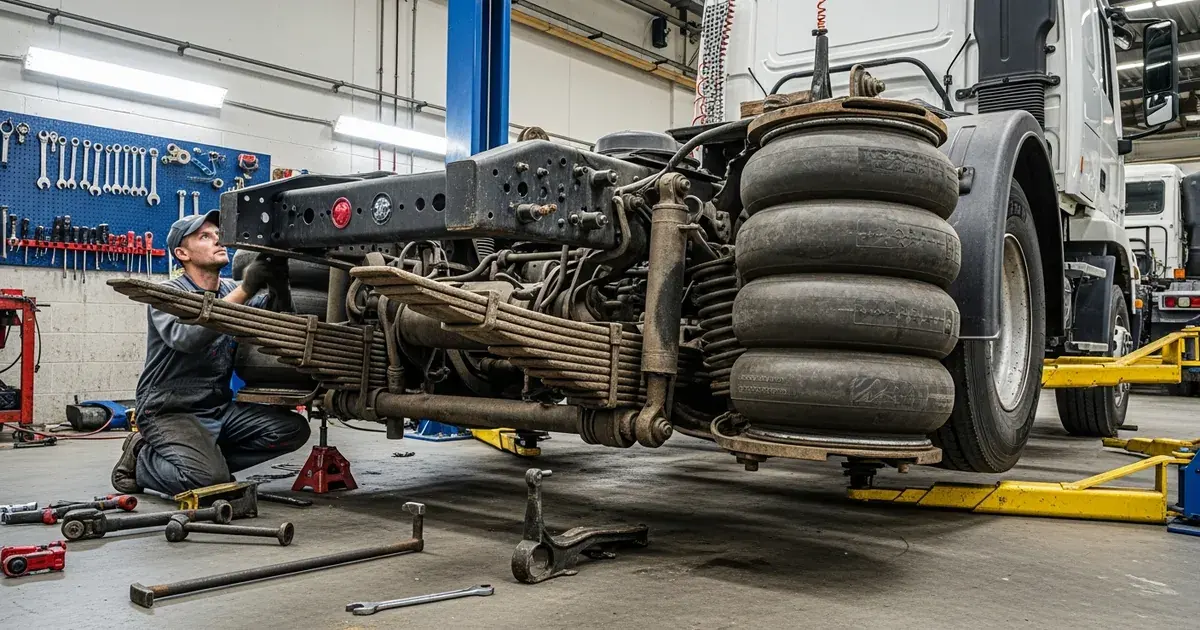
The suspension system on a heavy truck does far more than provide a comfortable ride. It maintains proper tire contact with the road, controls vehicle handling and stability, distributes load weight evenly across axles, and protects the cargo from damaging vibration. When suspension components fail, the effects cascade through the entire vehicle — tires wear unevenly, handling becomes unpredictable, driver fatigue increases, and cargo damage becomes more likely. Understanding how to diagnose suspension problems saves money and prevents secondary damage.
Leaf Spring Diagnosis
Leaf springs are the most common suspension type on commercial trucks, especially on steer and drive axles. A leaf spring assembly consists of multiple tempered steel leaves bound together, with the longest leaf (the main leaf) forming the primary load-bearing member. Common leaf spring problems include broken main leaf which is immediately visible and causes the affected corner to sag, separated leaves where the center bolt fails and individual leaves shift, causing noise and uneven load distribution, fatigued springs that have lost their arch and sit flatter than specification, reducing ride height and load capacity, and broken spring eyes where the mounting points crack from fatigue.
Diagnosis begins with a visual inspection. With the truck on level ground and loaded to operating weight, check for visible cracks, broken leaves, shifted leaves, and uneven ride height side to side. A difference of more than one inch in ride height between left and right sides indicates a spring problem on the lower side. Listen for clunking or squeaking sounds during slow-speed turning, which indicate loose or worn spring components.
Air Suspension Bag Diagnosis
Air ride suspension systems use air springs — reinforced rubber bags inflated to specific pressures by the truck's air system. Air suspension provides a smoother ride and allows ride height adjustment for dock loading. However, the rubber bags are vulnerable to damage from road debris, aging, and environmental exposure.
Common air bag problems include leaking bags that cause the affected corner or axle to sag when the truck sits overnight, cracked or split rubber from UV exposure and ozone degradation, mounting plate failures where the metal end caps separate from the rubber body, and ride height valve malfunctions that cause improper inflation.
To diagnose air bag issues, park the truck loaded on level ground and observe the ride height at each air bag position. Apply soapy water to the bag surface and watch for bubbles that indicate leaks. Listen for air leaking — a steady hiss near an air bag indicates a slow leak. Check ride height valves by manually moving the linkage and confirming that the valve responds with appropriate air flow.
Shock Absorber Assessment
Shock absorbers dampen spring oscillation — without them, the truck would bounce continuously after hitting a bump. Worn shock absorbers cause excessive bouncing, poor tire contact with the road, accelerated tire wear, and increased driver fatigue. On commercial trucks, shocks are especially important on steer axles where they affect steering stability and control.
The bounce test is the simplest diagnostic method. Press down firmly on each corner of the truck and release. The truck should return to its normal position and settle within one to two oscillations. If it continues to bounce three or more times, the shock absorbers on that position are worn.
Visual inspection reveals obvious problems — look for oil leaking from the shock body or shaft seal, bent or dented shock tubes, worn or missing bushings at the mounting points, and broken or cracked mounting brackets.
Walking Beam Suspension Issues
Walking beam suspension systems — common on tandem-drive axle configurations — use a pivoting beam between the two axles to distribute loads and maintain tire contact. Common walking beam problems include worn pivot bushings that cause excessive movement and noise, cracked beams from fatigue or overloading, worn saddle caps that allow the beam to shift on the axle, and torque rod failures that allow axle misalignment.
Diagnose walking beam problems by inspecting the pivot bushing for visible play. With the truck on level ground, attempt to rock the beam by hand at the pivot point. Any perceptible movement indicates worn bushings that need replacement. Inspect the beam surface for cracks, especially at the pivot point and saddle areas where stress concentrations occur.
Torque Rod and Bushing Problems
Torque rods maintain axle alignment and resist the twisting forces generated by acceleration and braking. Worn torque rod bushings allow the axle to shift position, causing tire scrubbing, accelerated tire wear, and handling problems. In severe cases, a failed torque rod can allow the axle to rotate out of alignment entirely.
Check torque rod bushings by visually inspecting for cracking, splitting, or separation of the rubber from the metal shells. With the parking brake set, attempt to move the axle forward and backward — any movement indicates worn bushings. Uneven tire wear on drive or trailer axles is often the first sign of torque rod bushing wear.
Ride Height Valve Calibration
Air suspension ride height valves control the inflation of air bags to maintain proper ride height regardless of load. A misadjusted or malfunctioning ride height valve causes the truck to ride too high or too low on the affected side, creating uneven tire wear, poor handling, and potential cargo damage from excessive vibration.
Verify ride height valve operation by measuring the distance from the frame rail to the axle at each air bag position. Compare measurements side to side and to the manufacturer's specification. Adjust the ride height valve linkage as needed to bring all positions within specification. If the valve does not respond to linkage adjustment, the valve itself may need replacement.
Kingpin Inspection
The kingpin connects the tractor's fifth wheel to the trailer. While technically a coupling component, kingpin wear directly affects the suspension and handling dynamic between tractor and trailer. A worn kingpin allows excessive lateral and longitudinal movement, causing handling instability, accelerated fifth wheel wear, and noise.
Kingpin wear is measured with a kingpin gauge. The maximum allowable wear for a standard 2-inch kingpin is typically 1/16 inch. Kingpins worn beyond specification must be replaced or built up with welding and machined back to specification.
For professional suspension diagnosis and mobile repair, call Weldon's Truck & Trailer at (334) 759-7020. Our mobile technicians carry suspension components and can perform leaf spring, air bag, shock absorber, and torque rod repairs at your location.