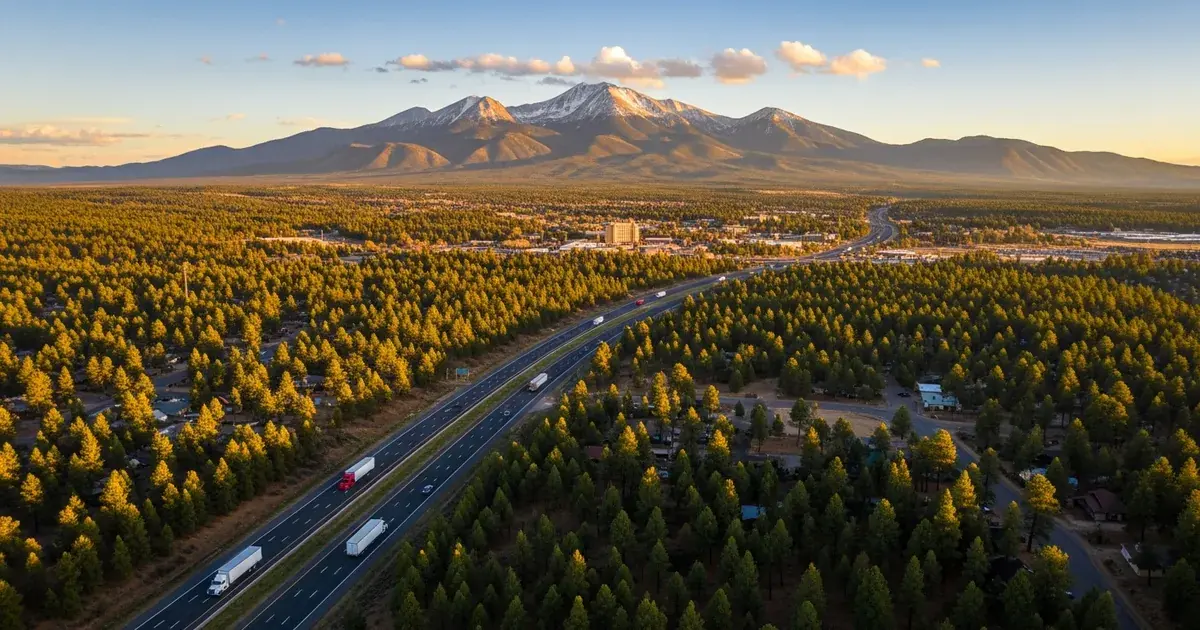
Flagstaff, Arizona sits at the intersection of two major freight corridors — Interstate 40 and Interstate 17 — at an elevation of 7,000 feet in Coconino County. This unique combination of geography, elevation, and route convergence makes Flagstaff the single most critical truck repair location in northern Arizona. Thousands of commercial vehicles pass through Flagstaff daily, and the mountain environment creates repair demands that do not exist at lower elevations.
The Geography That Makes Flagstaff Critical
Flagstaff sits atop the Colorado Plateau, surrounded by the San Francisco Peaks and Coconino National Forest. The approaches to Flagstaff from every direction involve significant grade changes. From the west on I-40, trucks climb steadily from Kingman at 3,300 feet to Flagstaff at 7,000 feet, with several steep grade sections near Williams and Parks. From the south on I-17, the climb from Phoenix at 1,100 feet to Flagstaff at 7,000 feet includes some of the steepest sustained grades in the Southwest, with the Munds Park to Flagstaff section being particularly challenging.
These grades put extraordinary stress on brake systems, engines, cooling systems, and transmissions. The combination of steep climbs under heavy load and long descents requiring continuous braking creates a failure environment that is unique to mountain trucking.
Mountain Grade Brake Challenges
The number one repair issue in Flagstaff is brake-related. The long descents approaching Flagstaff from both directions generate extreme brake temperatures. Trucks descending the I-17 grade from Flagstaff toward Camp Verde must manage a sustained 6 percent grade for several miles. At highway speed with a loaded trailer, this descent generates enough heat to glaze brake shoes, crack drums, and in extreme cases, cause brake fire.
Engine braking using Jake brakes is essential on these grades, but Jake brake restrictions exist in some areas near residential neighborhoods. Drivers must balance the need for engine braking against local noise ordinances, which sometimes means relying more heavily on foundation brakes than is ideal.
Brake inspection and maintenance should occur at higher frequency for trucks that regularly travel through Flagstaff. Standard brake inspection intervals designed for flat-terrain operations are insufficient for mountain routes. Trucks that run the I-17 corridor regularly should have brakes inspected every 25,000 to 30,000 miles rather than the standard 50,000-mile interval.
Elevation and Engine Performance
At 7,000 feet, the air density is roughly 20 percent lower than at sea level. This reduced air density directly affects engine performance — naturally aspirated engines lose approximately 3 percent of their power for every 1,000 feet of elevation gain. Turbocharged diesel engines compensate somewhat through turbocharger boost, but even turbo engines experience reduced power at high altitude.
The thinner air also affects cooling. Radiators are less efficient at high altitude because the reduced air density carries less heat away from the cooling fins. Engines that run at normal temperatures at sea level may run hotter at Flagstaff elevation, especially under the heavy load of climbing grades. Cooling system failures at altitude are common and can cause serious engine damage if not addressed immediately.
Winter Operations at Altitude
Flagstaff receives an average of 100 inches of snow annually. Winter operations in Coconino County present challenges including chain requirements on I-40 and I-17 during winter storms, black ice formation on bridges and overpasses, reduced traction on snow-packed and icy roads, cold-start difficulties when overnight temperatures drop below zero, diesel fuel gelling when temperatures fall below the fuel's cloud point, and frozen air system components including moisture-laden air lines and valves.
Chain installation and removal is a time-consuming process, and improperly installed chains can damage tires, fenders, and brake components. Chain damage repair is a common service call in the Flagstaff area during winter months.
The I-40 and I-17 Convergence
The intersection of I-40 and I-17 at Flagstaff creates a concentration of commercial traffic that amplifies the repair demand. East-west freight on I-40 moves between California ports, Phoenix distribution centers, and eastern markets. North-south freight on I-17 connects Phoenix — the fifth-largest city in the United States — with northern Arizona, southern Utah, and connections to I-40. This convergence means that a truck experiencing problems on either route needs service in the Flagstaff area.
The strategic importance of this junction is reflected in the volume of truck traffic. During peak periods, commercial vehicles account for a significant percentage of traffic on both I-40 and I-17 through Flagstaff. This volume, combined with the demanding terrain and weather conditions, creates a consistent need for professional truck repair services.
Roadside Service Coverage from Kingman
Weldon's Truck & Trailer provides mobile repair service to the Flagstaff area from our Kingman base. The I-40 corridor between Kingman and Flagstaff is one of our primary service areas, and our technicians are experienced with the specific types of breakdowns that mountain trucking produces. We carry brake components, cooling system parts, and winter-operation supplies specifically for Flagstaff-area calls.
For trucks broken down on I-40 or I-17 near Flagstaff, we dispatch fully equipped mobile repair units that travel the I-40 corridor to your location. Our technicians understand mountain-specific repair needs and arrive prepared to handle the brake, cooling, and cold-weather issues that are unique to this region.
For truck repair service in the Flagstaff area, call Weldon's Truck & Trailer at (334) 759-7020. We provide 24/7 emergency service throughout the I-40 and I-17 corridor in Coconino County.