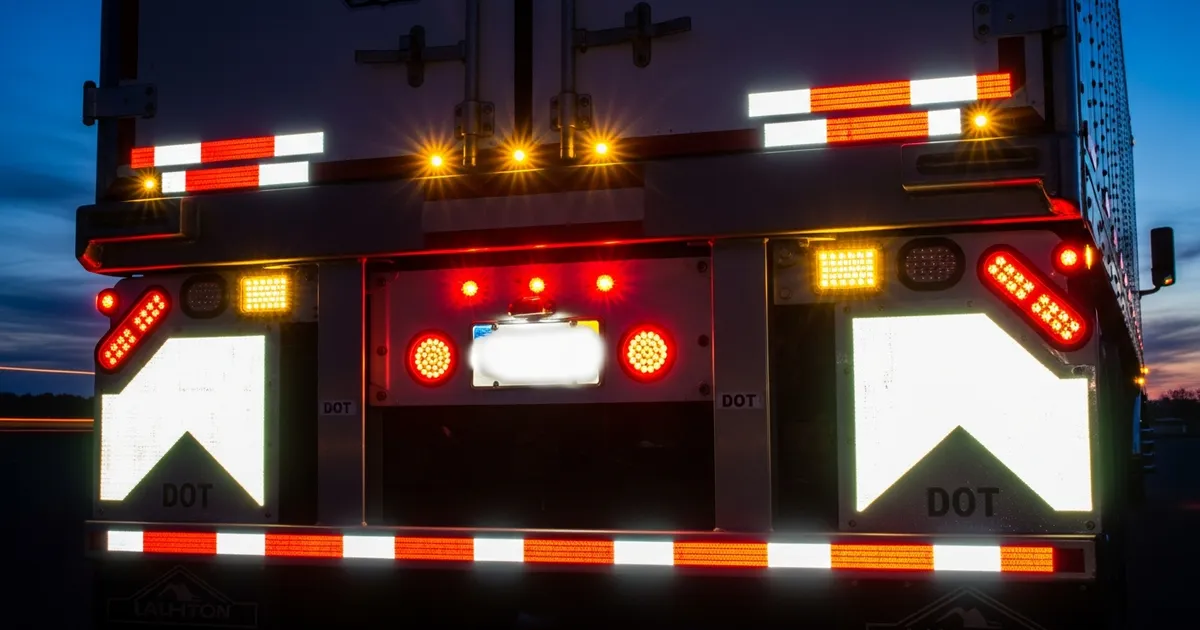
Lighting violations consistently rank as the second most common category of DOT out-of-service orders for commercial motor vehicles. Despite being among the easiest violations to prevent and fix, lighting deficiencies account for thousands of out-of-service orders annually across Arizona and Nevada. Understanding Federal Motor Vehicle Safety Standard 108 (FMVSS 108) requirements, knowing the most common failure points, and carrying the right supplies for quick fixes can keep you compliant and on the road.
FMVSS 108: The Federal Lighting Standard
FMVSS 108 is the comprehensive federal standard governing all lighting, reflective devices, and associated equipment on motor vehicles. For commercial trucks and trailers, this standard specifies the exact number, color, location, and visibility requirements for every lamp and reflector on the vehicle. DOT inspectors use FMVSS 108 as the definitive reference when evaluating lighting compliance.
The standard divides vehicle lighting into several categories. Required lamps include headlamps providing high and low beam illumination, turn signal lamps visible from front and rear, stop lamps that activate when brakes are applied, tail lamps that illuminate when headlamps are on, clearance lamps that mark the overall width and height of the vehicle, side marker lamps that mark the length of vehicles over 80 inches wide, identification lamps grouped in clusters of three that identify the presence of a wide vehicle, backup lamps, and license plate illumination.
Each category has specific requirements for color — amber for front and side-facing lamps, red for rear-facing lamps — and minimum candlepower output for visibility at specified distances. An inspector does not need specialized equipment to identify most violations — a visual check during daylight or a simple function test is sufficient.
The Most Common Lighting Violations
Data from CVSA roadside inspections shows consistent patterns in lighting violations. The single most common violation is inoperative clearance lamps and identification lamps. These small marker lights on the top and sides of trucks and trailers are exposed to road debris, vibration, and weather damage. Their failure often goes unnoticed by drivers because they do not affect the driver's ability to see the road — they affect other drivers' ability to see the truck.
The second most common violation involves DOT reflective tape and conspicuity marking deficiencies. FMVSS 108 requires alternating red and white DOT reflective tape (conspicuity marking) on the sides and rear of all trailers manufactured after December 1993. The tape must cover at least 50 percent of the trailer's length on each side, and the rear must have conspicuity marking across the full width. Missing, damaged, or faded tape that has lost its reflective capability is a citable violation.
Inoperative tail lamps and stop lamps are the third most common category. These failures are more serious because they directly affect following traffic's ability to see the truck, especially during braking. A single inoperative stop lamp on a tractor or trailer is a violation, and both stop lamps inoperative on the same unit may result in an out-of-service order.
Turn signal failures, while less common than marker light issues, carry significant safety implications and higher severity weights in the CSA scoring system. A non-functioning turn signal eliminates the vehicle's ability to communicate lane changes and turns to surrounding traffic.
Quick Fixes for Common Lighting Issues
Many lighting violations can be corrected roadside with basic tools and supplies. Carrying a lighting repair kit on your truck is one of the simplest ways to prevent lighting-related out-of-service orders.
For incandescent bulb replacements, keep a supply of common bulb types: 1157 dual-filament bulbs for stop and tail lamp combinations, 194 miniature bulbs for clearance and marker lamps, and 3157 bulbs for turn signals. These three bulb types cover the majority of lighting positions on most trucks and trailers. Bulb replacement typically requires removing two or three screws to access the lens, swapping the bulb, and reinstalling the lens — a five-minute repair.
For LED lighting, which is increasingly common on newer equipment, failures are typically caused by connector corrosion, water intrusion, or vibration-loosened connections rather than individual LED failure. Check the electrical connector at the back of the lamp housing. Clean corroded pins with electrical contact cleaner and apply dielectric grease to prevent future corrosion. If the LED unit itself has failed, replacement is straightforward — most LED marker lights are sealed units that plug into the existing wiring harness.
For DOT reflective tape repairs, carry a roll of DOT-C2 conspicuity marking tape in both red and white. The tape is self-adhesive and can be applied to clean, dry surfaces in minutes. Clean the trailer surface with rubbing alcohol before application to ensure adhesion. Replace any section of tape that is peeling, faded, or missing reflective capability.
Wiring and Connector Problems
While individual lamp failures are the most visible lighting issues, wiring and connector problems are the most common root cause of repeated failures. The wiring harness on a commercial trailer is subjected to constant flexion, vibration, road salt, water exposure, and UV degradation. Over time, wire insulation cracks, connectors corrode, and ground connections deteriorate.
The most common wiring failure point is the trailer plug connection. The seven-way trailer plug carries all lighting circuits between the tractor and trailer, and it is exposed to road spray, dirt, and mechanical stress every time the trailer is coupled or uncoupled. Inspect the plug pins for corrosion, bent contacts, and proper seating. Clean corroded pins with a wire brush and apply dielectric grease.
Ground connection failure is another frequent cause of lighting problems. Every lighting circuit requires a clean, solid ground connection to complete the circuit. When ground connections corrode — which happens rapidly in wet or salty conditions — lamps may glow dimly, flicker, or fail entirely. Some trailers ground each lamp individually to the frame through a dedicated wire, while others use the mounting hardware as the ground path. In either case, corroded grounds cause intermittent and frustrating lighting failures.
Check ground connections at every PM interval. Clean all ground attachment points to bare metal, apply anti-corrosion compound, and verify continuity with a multimeter. A five-minute ground connection check can prevent hours of troubleshooting intermittent lighting issues.
Clearance Lamp and Identification Lamp Requirements
Clearance lamps mark the overall width of the vehicle at the top corners, and identification lamps are the cluster of three amber lights centered at the top of the cab face and three red lights centered at the top of the trailer rear. These lamps are required on all vehicles over 80 inches wide.
Inspectors pay particular attention to identification lamp clusters because they are a quick visual indicator of the vehicle's width to approaching traffic, especially at night. All three lamps in each identification cluster must be functional — a single inoperative lamp in the cluster is a violation. The lamps must be spaced between 6 and 12 inches apart, center to center, and must be horizontally centered on the vehicle.
Clearance lamps at the top corners must show amber to the front and red to the rear. Side marker lamps along the length of the vehicle must show amber on the front half and red on the rear half. These color requirements are absolute — a red lamp in an amber position or vice versa is a violation regardless of whether the lamp functions.
Inspection Preparation: Lighting Checklist
Before every trip and at every PM interval, perform a complete lighting function check. The most efficient method requires a helper or a reflective surface such as a loading dock door. Turn on all lighting systems in sequence. Start with headlamps on low and high beam. Activate turn signals left and right, verifying front and rear function. Apply brakes and verify all stop lamps illuminate. Turn on clearance and marker lamps, then walk the entire vehicle checking every lamp position. Verify identification lamp clusters on the cab and trailer rear. Check license plate illumination. Inspect all conspicuity marking for damage and reflectivity.
For professional electrical and lighting repair or to learn more about compliance requirements, see our guide on trailer lighting regulations and DOT compliance.
For mobile lighting repair and DOT compliance service, call Weldon's Truck & Trailer at (334) 759-7020. Our service trucks carry a complete inventory of bulbs, LED units, connectors, and DOT reflective tape for immediate roadside repairs.