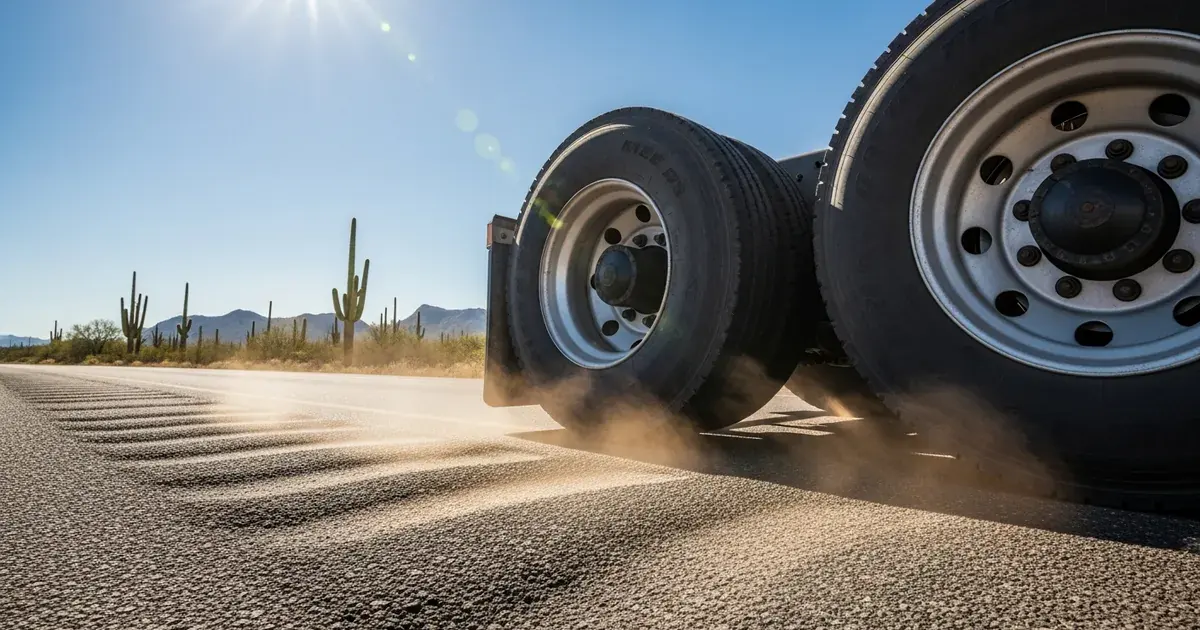
The Mojave Desert and Sonoran Desert regions of Arizona and Nevada are among the harshest environments for commercial truck tires anywhere in the world. When ambient temperatures reach 115°F and pavement surface temperatures soar past 160°F, the physics working against your tires become overwhelming. Understanding how desert heat destroys tires — and what you can do to prevent failures — is essential knowledge for any trucker operating in the Southwest.
The Physics of Heat and Tire Failure
Every tire generates heat through flexion — the constant deformation of the tire as it contacts the road surface. Under normal conditions, the tire dissipates this heat into the surrounding air fast enough to maintain safe operating temperatures. In desert conditions, this heat dissipation equation breaks down. When the ambient temperature is already 115°F and the pavement is 160°F or higher, the tire cannot shed heat fast enough. Internal temperatures climb past the tire's design limits, causing the rubber compounds to break down and the structural bonds between the tread, belts, and casing to weaken.
This is why tire blowouts spike dramatically during summer months in the Southwest. The heat index is simply too high for tires to maintain structural integrity, especially under heavy loads.
How Underinflation Accelerates Heat Damage
A tire pressure monitoring system can be your most valuable tool in the desert. Underinflated tires flex more with each revolution, generating significantly more internal heat. A tire that is 20 percent underinflated generates roughly 25 percent more heat than a properly inflated tire — a dangerous margin when ambient temperatures are already extreme.
Counterintuitively, many drivers underinflate their tires in summer, thinking that lower pressure will prevent overheating. This is exactly wrong. Lower pressure increases flexion, which increases heat generation. The correct approach is to set tire pressure to the manufacturer's specification when the tire is cold — before the day's heat affects the reading. Early morning, before sunrise, provides the most accurate cold pressure reading in the desert.
Tread Depth and Desert Survival
Tread depth affects more than just traction. Deeper tread channels dissipate heat more effectively than worn tread. A tire with 8/32-inch tread depth runs significantly cooler than one with 4/32-inch tread depth under identical conditions. In the desert, running tires down to minimum legal tread depth dramatically increases the risk of heat-related failure.
For commercial drivers operating regularly in the Mojave Desert and Southwest, we recommend replacing steer tires at 6/32-inch tread depth and drive tires at 4/32-inch tread depth — well above the legal minimums. The cost of early replacement is far less than the cost of a high-speed blowout.
Sidewall Damage: The Silent Killer
UV radiation in the desert degrades tire sidewall rubber over time. The sun's ultraviolet rays break down the chemical bonds in the rubber compound, causing cracking, checking, and eventual structural failure. This process is called weathering, and it happens much faster in the Southwest than in other regions.
Inspect tire sidewalls carefully during every pre-trip inspection. Look for fine cracks in the sidewall surface, especially near the bead area and shoulder. If sidewall cracking is visible from arm's length, the tire should be replaced regardless of remaining tread depth. A structurally compromised sidewall will fail under the stress of desert heat and highway speeds.
Retread Tires in Extreme Heat
Retread tires are common in commercial trucking, and they perform well in moderate conditions. However, desert heat puts extra stress on the bond between the retread and the casing. If the bonding process was imperfect or the casing is aged, extreme heat can cause tread separation — the retread peels away from the casing while the truck is moving. This creates the "road alligators" you see scattered across desert highways.
If you use retread tires, ensure they come from a reputable retreader and are mounted on quality casings. Never use retreads on steer axles. Inspect retreaded tires more frequently during summer months, looking for any signs of tread edge lifting or separation.
Dual-Tire Assembly Hazards
Dual-tire assemblies on drive and trailer axles present special risks in desert heat. When two tires run side by side, heat from one tire radiates to its partner, creating a heat trap between the two tires. If one tire is slightly underinflated, it runs hotter, which heats the adjacent tire, creating a cascading failure condition.
Always check both tires in a dual assembly and ensure they are matched in size, tread depth, and inflation pressure. A difference of more than 5 PSI between paired duals creates uneven loading and accelerated wear. Consider using a tire pressure monitoring system that monitors each individual tire position to catch developing problems early.
Emergency Response: When Blowouts Happen
Despite best prevention practices, tire blowouts still happen in the desert. When they do, the priority is safety. Steer tire blowouts require firm control of the steering wheel without overcorrecting. Drive tire blowouts may cause the truck to pull to the side of the blowout. In either case, gradually reduce speed and move to the shoulder — never slam on the brakes.
Once safely stopped, set out warning triangles and call for mobile tire service. Attempting to change a commercial truck tire in 115°F heat without proper equipment is dangerous. Our mobile tire repair units carry all necessary equipment and replacement tires to handle any tire emergency safely.
For 24/7 mobile tire repair service in the desert Southwest, call Weldon's Truck & Trailer at (334) 759-7020. We carry steer, drive, and trailer tires in common sizes and respond quickly throughout our service area.