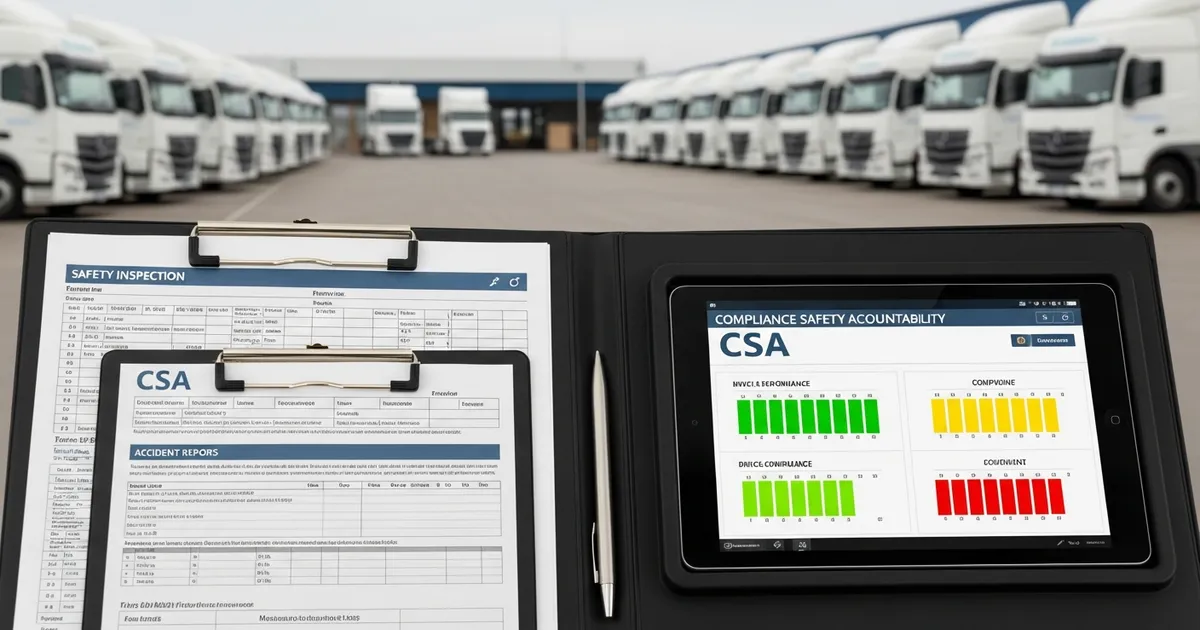
The Compliance Safety Accountability program is FMCSA's primary system for evaluating the safety performance of commercial motor carriers and drivers. Your CSA scores directly influence whether FMCSA targets you for intervention, how much you pay for insurance, and whether shippers and brokers will work with you. Of the seven BASIC (Behavior Analysis and Safety Improvement Categories) categories that make up your CSA profile, the Vehicle Maintenance BASIC is one of the most directly controllable through proactive maintenance practices.
Understanding the Safety Measurement System
FMCSA's Safety Measurement System (SMS) collects data from roadside inspections, crash reports, and investigation results to calculate your scores in seven BASIC categories: Unsafe Driving, Hours-of-Service Compliance, Driver Fitness, Controlled Substances and Alcohol, Vehicle Maintenance, Hazardous Materials Compliance, and Crash Indicator.
Each BASIC score is expressed as a percentile ranking from 0 to 100, where higher numbers indicate worse safety performance relative to peer carriers. The Vehicle Maintenance BASIC threshold for intervention is 80 percent for general carriers — meaning if your maintenance score is above the 80th percentile, you are at risk for FMCSA warning letters, targeted inspections, and compliance reviews.
How Vehicle Maintenance Violations Impact Your Score
Every violation found during a roadside inspection is entered into the SMS database and assigned a severity weight. Brake violations carry the highest severity weights because of their direct safety impact. A single brake adjustment violation carries a severity weight of 4, while a brake out-of-service violation carries an 8. An inoperative light violation carries a severity weight of 1 or 2 depending on the specific light.
These violations are time-weighted over 24 months — recent violations count more heavily than older ones. However, even a single serious maintenance violation can significantly impact a small carrier's percentile ranking. For a carrier with only a few inspections, one bad inspection can push your Vehicle Maintenance BASIC above the intervention threshold.
The Financial Impact of Poor CSA Scores
Poor CSA scores create a cascading financial impact. Insurance premiums increase as underwriters view carriers with high maintenance scores as higher risk. Many shippers and brokers use CSA scores as a screening criterion — a Vehicle Maintenance score above 65 can result in losing access to premium freight. FMCSA intervention activities consume management time and can result in conditional or unsatisfactory carrier safety ratings that restrict your operating authority.
The Inspection Selection System (ISS) uses CSA data to prioritize vehicles for roadside inspection. Carriers with high CSA scores are flagged for more frequent inspections, which creates a compounding effect — more inspections mean more opportunities for violations, which further increase your scores.
Maintenance Practices That Improve CSA Scores
The most effective way to improve your Vehicle Maintenance BASIC is to ensure your vehicles pass roadside inspections consistently. This requires a comprehensive preventive maintenance program that addresses the most common violation categories.
Brake system maintenance is the highest priority. Inspect brake adjustment, lining thickness, drum condition, and air system integrity at every PM interval. Adjust or replace components proactively before they reach violation thresholds. The difference between a brake that is at the limit and one that is clearly within specification can be the difference between a clean inspection and an out-of-service violation.
Lighting compliance is the second most common maintenance violation category. Inspect all lights at every pre-trip and PM visit. Replace any light that is dim, flickering, or showing signs of moisture intrusion. Keep spare bulbs, fuses, and lighting components on the truck for immediate replacement when issues are found during the trip.
Tire and wheel maintenance directly impacts both safety and CSA scores. Maintain tread depth well above minimum requirements, verify inflation at every pre-trip, and inspect for damage or irregular wear patterns that indicate alignment or suspension problems.
Pre-Trip Inspection as CSA Defense
A thorough daily pre-trip inspection is your first line of defense against CSA violations. If your drivers identify and correct issues before the truck leaves the yard, those issues will never appear on a roadside inspection. Train drivers to perform genuine, comprehensive pre-trip inspections rather than cursory walk-arounds.
The Driver Vehicle Inspection Report (DVIR) documents the pre-trip inspection results. A complete, accurate DVIR demonstrates to inspectors that the carrier takes maintenance seriously. An incomplete or clearly fabricated DVIR raises red flags that may prompt a more thorough inspection.
DataQs: Challenging Incorrect Violations
If a violation recorded during a roadside inspection is incorrect or unfounded, carriers can challenge it through the FMCSA DataQs system. Common grounds for challenge include violations recorded for the wrong vehicle, violations that were corrected before the inspection began, and errors in the inspection report that affect severity weights.
The DataQs process requires documentation — photographs, maintenance records, and receipts that prove the violation was recorded in error. Maintain detailed records of all maintenance performed, including dates, mileage, components replaced, and technician information. These records support DataQs challenges and demonstrate your maintenance program's thoroughness.
Building a CSA-Focused Maintenance Culture
Improving and maintaining good CSA scores requires a maintenance culture that goes beyond checking boxes. Every person in the organization — from drivers to mechanics to management — must understand how their actions affect CSA scores and commit to maintaining vehicles above the standard, not just at the standard.
Regularly review your CSA scores through the SMS website. Analyze which violation types are driving your score and focus maintenance efforts on those categories. Track your clean inspection rate — the percentage of inspections with no violations — as a key performance metric.
For fleet maintenance programs designed to improve and maintain excellent CSA scores, call Weldon's Truck & Trailer at (334) 759-7020. We provide comprehensive PM services with detailed documentation that supports your compliance efforts.