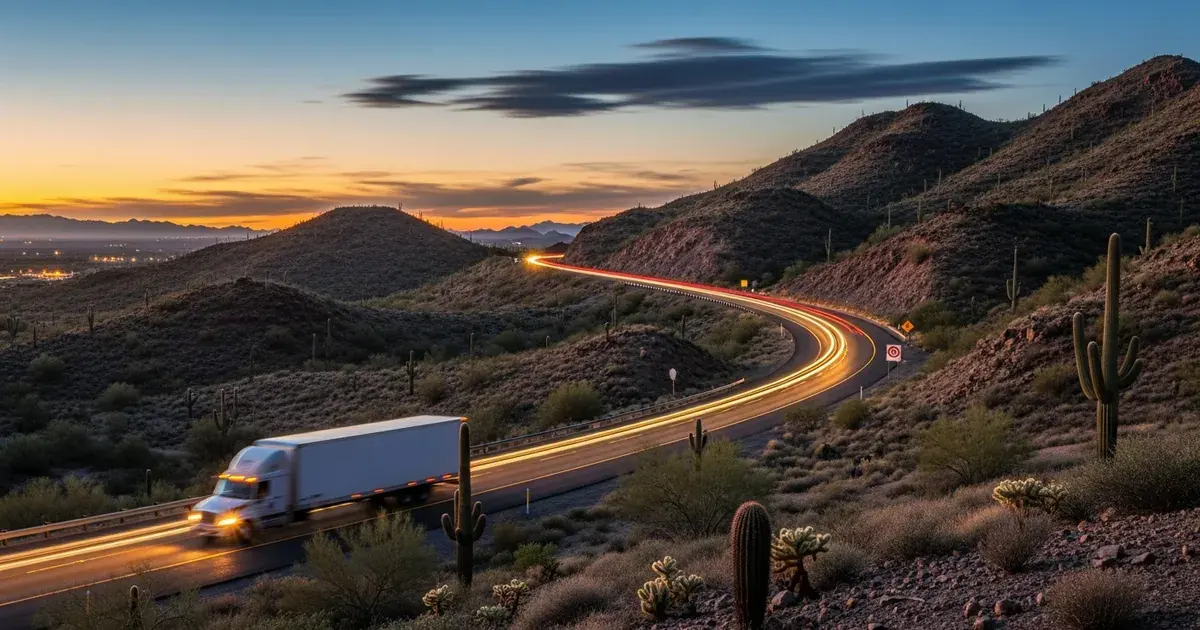
US Route 93 between Bullhead City and Kingman, Arizona is a critical commercial corridor in Mohave County that connects the Colorado River communities with the I-40 interstate system. This 30-mile stretch of highway crosses some of the most extreme terrain in western Arizona — steep mountain grades, desert temperatures that routinely exceed 115°F in summer, and long stretches with no services. For commercial truck operators, understanding the specific challenges of this corridor and having a repair plan in place is essential.
The US-93 Corridor: Geography and Traffic
Bullhead City sits on the Colorado River at an elevation of approximately 540 feet — one of the lowest points in Arizona. Kingman sits at approximately 3,300 feet on the Hualapai Plateau. The US-93 corridor between the two cities must climb nearly 2,800 feet of elevation in approximately 30 miles, creating sustained grades that challenge every loaded truck.
The corridor carries significant commercial traffic serving multiple purposes. Freight moving between the Laughlin/Bullhead City gaming and tourism economy and the I-40 distribution network passes through on US-93. Construction materials, fuel tankers, and supply trucks serving the Colorado River communities use this route daily. Agricultural products from the Mohave Valley travel north through Kingman to reach I-40 and national distribution networks.
The traffic volume and the demanding terrain create a consistent need for truck repair services along the corridor. Our mobile repair units travel US-93 regularly, and we maintain familiarity with the specific breakdown challenges this route presents.
Climbing the Grade: Engine and Cooling System Stress
The northbound climb from Bullhead City to Kingman is the more demanding direction for loaded trucks. The sustained grade, combined with summer desert temperatures that can reach 120°F near the Colorado River, creates extreme stress on engine cooling systems, turbochargers, and transmissions.
Engine coolant temperatures climb steadily during the grade ascent. A cooling system that maintains 200°F on level highway may reach 225°F to 235°F during the climb — approaching the danger zone where head gasket failure and cylinder liner distortion become risks. Trucks with marginal cooling systems — older radiators with partially blocked cores, slightly low coolant levels, or aging thermostats — are the most vulnerable.
The turbocharger also works at maximum capacity during the climb, compressing intake air at maximum boost pressure for extended periods. This sustained maximum-output operation heats the turbocharger housing and shaft bearings, and any lubrication deficiency can cause rapid bearing failure. Trucks experiencing reduced power or excessive exhaust smoke during the climb should not attempt to push through — pull over, allow the engine and turbocharger to cool, and call for diagnosis.
Descending the Grade: Brake System Demands
The southbound descent from Kingman to Bullhead City requires sustained brake application over multiple miles. Trucks that rely solely on foundation brakes rather than engine braking will generate dangerous brake temperatures during this descent. Brake fade — the loss of braking effectiveness caused by overheated brake components — is a real risk on the US-93 descent.
Use the engine brake (Jake brake) as your primary speed control on the southbound descent. Select a gear that allows the engine brake to control speed without foundation brake application. If you must use foundation brakes, apply them firmly to slow the truck to 5 mph below your target speed, then release them completely to allow cooling before the next application. This intermittent application technique maintains lower average brake temperatures than dragging the brakes continuously.
Desert Temperature Extremes
The Bullhead City area regularly records some of the highest temperatures in Arizona. Summer highs of 118°F to 122°F are not uncommon near the Colorado River, and the canyon geography of the river valley traps and concentrates heat. Even in the early morning, temperatures may be 90°F to 95°F — offering little relief for temperature-sensitive truck systems.
These extreme temperatures affect every system on the truck simultaneously. Tires are running on superheated pavement. The engine cooling system is fighting a smaller temperature differential for heat rejection. Battery electrolyte is evaporating faster. Air conditioning systems are running at maximum capacity, adding parasitic load to the engine. Belt and hose rubber compounds are degrading faster from heat exposure.
For trucks operating regularly in the Bullhead City area, maintenance intervals should be the most aggressive in your fleet — 20 to 30 percent shorter than manufacturer recommendations for every fluid, filter, belt, and hose on the vehicle.
Breakdown Response in the Corridor
A breakdown on US-93 between Bullhead City and Kingman places the truck in a remote desert environment with limited cell coverage in some areas and summer conditions that can quickly become a medical emergency. Our Kingman-based mobile repair units can reach any point on the US-93 corridor within 30 to 60 minutes, carrying the parts and equipment for the most common corridor breakdowns.
We see a consistent pattern of breakdown types on US-93: cooling system failures during summer climbs — radiator hoses, water pumps, and thermostats that give way under maximum stress. Tire blowouts from heat-loaded pavement, particularly on the lower-elevation Bullhead City end of the route. Brake component failures — glazed shoes, cracked drums, and overheated chambers — from southbound grade descents. Electrical failures from heat-damaged wiring and connections.
Each of these repairs requires a technician who understands the urgency of working in extreme heat and the importance of a thorough repair that will hold up for the rest of the trip. A patch job that gets the truck off the shoulder but fails again 50 miles down the road serves no one.
Connecting Bullhead City to the Broader Network
Bullhead City's position on the Colorado River makes it a gateway between Arizona and the Laughlin, Nevada gaming corridor. Commercial traffic supporting the casino and hospitality industry — food service trucks, linen delivery, beverage distribution, and construction materials — flows constantly across the river. This traffic connects northward through Kingman to I-40, where it joins the national freight network.
For truckers serving this corridor, visit our Bullhead City service area page and learn about our emergency roadside repair capabilities throughout Mohave County.
For 24/7 truck repair service on US-93 between Bullhead City and Kingman, call Weldon's Truck & Trailer at (334) 759-7020. We are based in Kingman and respond rapidly to corridor breakdowns.