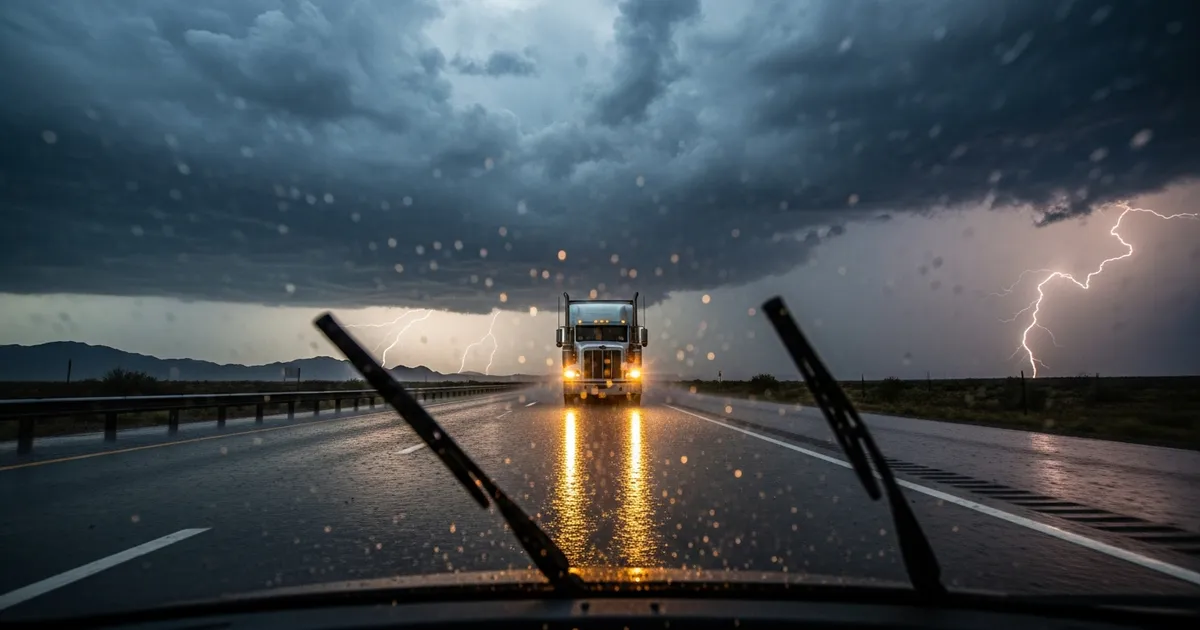
Arizona's monsoon season runs from mid-June through September, bringing some of the most dramatic and dangerous weather in the Southwest. For commercial truck drivers, monsoon conditions create hazards that differ fundamentally from the typical winter storm risks. The National Weather Service issues monsoon-related warnings that every trucker operating in Arizona should understand and respect. Flash floods, dust storms called haboobs, sudden downpours, and high winds can turn a routine highway drive into a life-threatening situation in minutes.
Understanding the Arizona Monsoon
The monsoon is a seasonal shift in wind patterns that draws moisture from the Gulf of California and Gulf of Mexico into the Southwest. This moisture fuels intense thunderstorms that develop rapidly in the afternoon and evening hours. These storms can produce rainfall rates of one to two inches per hour — enough to create flash flooding within minutes on the normally dry desert terrain.
Unlike winter storms that develop over large areas and can be tracked for days, monsoon thunderstorms are highly localized and can go from clear sky to violent storm in 30 minutes. They move quickly and unpredictably, making them particularly dangerous for highway travelers.
Flash Flood Safety for Truckers
Flash flood warning situations are the most dangerous aspect of monsoon season. Arizona's desert terrain has virtually no absorption capacity — when heavy rain falls, the water runs off immediately, filling washes, arroyos, and low-lying road crossings with fast-moving water. A six-inch depth of fast-moving water can sweep a passenger car off the road. For commercial trucks, the higher ground clearance provides some protection, but the massive surface area of a trailer creates enormous drag forces in moving water.
Never drive through flooded roadways. Arizona's pull-aside law requires drivers to pull off the road and stop when visibility or road conditions become dangerous during a dust storm or severe weather event. The water depth at a flooded crossing can be far greater than it appears, and the road surface beneath may be undermined or washed away. If you encounter a flooded section of highway, stop and wait for the water to recede or find an alternate route.
Dust Storms and Haboobs
A haboob is a massive wall of dust that can be thousands of feet tall and tens of miles wide. These dust storms form when the outflow boundary of a collapsing thunderstorm pushes a wall of dust ahead of it across the desert floor. A haboob can reduce visibility to zero in seconds and last for 10 to 30 minutes.
Arizona law and common safety practice require the following response when you encounter a dust storm while driving: immediately pull completely off the road to the right, as far from travel lanes as possible. Turn off all lights including headlights and taillights — this prevents other drivers from using your lights as a guide and driving into your parked truck. Set your parking brake and take your foot off the brake pedal to ensure your brake lights are off. Wait until the storm passes and visibility is restored before resuming travel.
For commercial trucks, the high profile of the trailer creates enormous wind resistance during a haboob. High winds accompanying the dust wall can push an empty trailer sideways or even tip it. If you see a dust wall approaching and cannot pull off the road immediately, reduce speed, turn on your hazard lights until you can stop, and prepare for sudden wind gusts.
Hydroplaning and Wet Road Hazards
Desert roads accumulate a layer of oil, rubber residue, and dust during the long dry months. When the first monsoon rain falls, this layer becomes extremely slick — much more slippery than the same road would be after several days of rain have washed the surface clean. The first rain of monsoon season is statistically the most dangerous for accidents.
Commercial trucks are particularly susceptible to hydroplaning because their high weight concentrates pressure on each tire, which can actually cut through the water layer more effectively than lighter vehicles. However, an empty or lightly loaded trailer has reduced tire pressure on the road surface, increasing hydroplaning risk significantly. Reduce speed in wet conditions, increase following distance to at least eight to ten seconds, and avoid standing water.
Brake System Concerns During Monsoon
Wet brake drums and shoes lose friction, requiring longer stopping distances. After driving through standing water or heavy rain, lightly apply the brakes for a few hundred yards to dry the drum surfaces. Listen for unusual sounds that indicate water has entered the brake system. Air brake systems can also absorb moisture through the air intake — ensure your air dryer is functioning properly and drain air tanks at every stop during monsoon season.
Lightning Safety
Arizona monsoon storms produce significant lightning. While the truck cab provides reasonable protection as a Faraday cage, be cautious when outside the vehicle during storms. Avoid touching the truck's metal body during active lightning. If you are performing a pre-trip inspection or roadside repair when lightning approaches, get inside the cab immediately.
Communication and Planning
Monitor weather conditions continuously during monsoon season. National Weather Service Flagstaff covers northern Arizona, while NWS Phoenix covers the central and southern regions. Download the NOAA weather app or tune to weather radio frequencies for real-time alerts. Plan routes to avoid known flash flood zones — local knowledge from dispatchers and fellow drivers is valuable.
If you break down during monsoon weather, prioritize getting to a safe location before calling for service. If you are in a wash or low-lying area, move to higher ground even if it means leaving the truck temporarily. Your safety is more important than the vehicle.
For emergency roadside service during monsoon season or any weather conditions, call Weldon's Truck & Trailer at (334) 759-7020. We respond 24/7 regardless of weather conditions.